
2×2 4k Video Wall Controller
4.6Editor score
Supports HDMI and DVI inputs
Features 11 splicing modes
Includes 180 degree image rotation
This comprehensive guide compares the top HDMI Video Wall Controller models for 2026, analyzing features, compatibility, and performance to help you choose the
Video wall controllers enable seamless integration of multiple displays into a single cohesive visual experience. These devices process input signals and distribute them across several screens, creating stunning large-scale displays for businesses and entertainment venues alike.
We evaluated ten leading HDMI Video Wall Controller models based on resolution support, display modes, connectivity options, and ease of use. Each product offers unique strengths for different installation needs, from simple two-screen setups to complex multi-display configurations.
Every selection highlights key specifications, pros, cons, and ideal use cases to guide your purchasing decision. Please note that product availability and pricing may vary over time, so verify current details before making your final commitment to a specific model.
4.6Editor score

4.8Editor score

4.2Editor score
The following table provides a side-by-side comparison of all ten reviewed HDMI Video Wall Controller models. Examine their core specifications, supported resolutions, and connectivity options to determine which device best fits your specific display requirements and budget constraints.



This J-Tech Digital controller delivers reliable performance for creating professional 4K video walls. With a strong rating and comprehensive features, it stands out as a top choice for users seeking seamless multi-display integration without compromising quality.
We may earn a commission when you buy through this link, at no additional cost to you.
It supports 4K@30Hz input and offers eight display modes including 2×2 and 1×4 configurations. Audio extraction via SPDIF optical and 3.5mm ports ensures high-quality sound routing, while edge masking minimizes bezel gaps for a polished look.
While output resolution is fixed at 1080p and HDR10 is not supported, these trade-offs are acceptable for most commercial applications. The controller excels in stability and ease of use, making it suitable for both simple and complex installations.
Businesses and educators looking for a dependable HDMI video wall controller should consider this model. Its balance of features and performance makes it a smart investment for professional display setups requiring precise control and clarity.
Combine up to four HDMI displays into one cohesive video wall with minimal setup effort.
Adjust edge masking up to eight pixels to eliminate distortion and achieve a seamless visual experience.
We may earn a commission when you buy through this link, at no additional cost to you.
This budget-friendly controller offers exceptional value for users needing basic multi-screen display functionality. It supports both HDMI and DVI inputs, making it versatile for older setups while maintaining modern 4K input capabilities.
We may earn a commission when you buy through this link, at no additional cost to you.
Its 11 splicing modes and 180-degree rotation provide flexibility for various screen arrangements. The memory function remembers settings after power cycles, and audio output via 3.5mm ensures seamless sound integration without additional hardware.
While DVI inputs do not support 4K resolution, HDMI handles high-definition signals effectively. This limitation is minor for small businesses focused on cost-effective solutions rather than premium display quality.
Ideal for small retail displays or home entertainment setups, this controller delivers reliable performance at a fraction of the cost of higher-end models. It is a practical choice for budget-conscious users.
Support both modern HDMI and legacy DVI inputs for broader device compatibility and flexible deployment options.
Use IR remote, RS232, or button controls to switch modes and adjust settings without technical expertise.
We may earn a commission when you buy through this link, at no additional cost to you.
This premium controller supports true 4K60Hz input and offers web-based control for remote management. Its ability to scale resolutions and route signals seamlessly makes it ideal for professional environments demanding high-performance visual systems.
We may earn a commission when you buy through this link, at no additional cost to you.
Features like multiviewer presets and zero-switching delay ensure smooth transitions between content sources. LAN connectivity allows operators to adjust displays from any networked device, providing unmatched flexibility for large-scale installations.
The higher price and configuration complexity may deter casual users. However, for mission-critical applications like broadcast studios or large conference rooms, the advanced features justify the investment and deliver superior performance.
Advanced users and enterprises should prioritize this model for its robust capabilities. It sets a high standard for premium video wall control, offering reliability and customization unmatched by entry-level alternatives.
Manage video wall settings via LAN and web interface for flexible, centralized control across large facilities.
Support 4K60Hz inputs with seamless switching to ensure fluid visuals for fast-paced or live content.
We may earn a commission when you buy through this link, at no additional cost to you.
This OREI model is an excellent choice for modern setups requiring USB-C connectivity. It supports 4K@60Hz inputs and offers versatile display modes, making it suitable for diverse professional applications.
We may earn a commission when you buy through this link, at no additional cost to you.
RS-232 control enables automation and integration with professional systems. Audio extraction via optical and L/R outputs ensures high-quality sound routing, while the dual-voltage supply supports international installations without adapters.
While it lacks HDR10 support and output is fixed at 1080p, these constraints are manageable for most business environments. Its compatibility with USB-C sources gives it an edge over competitors with HDMI-only inputs.
Organizations using modern laptops and media players will appreciate this controller's versatility. It delivers strong performance for the price and ensures seamless integration with cutting-edge devices and international standards.
Connect directly to USB-C sources like laptops and media players without needing additional adapters or converters.
Dual voltage supply and included adapters ensure reliable operation regardless of local power standards or region.
We may earn a commission when you buy through this link, at no additional cost to you.
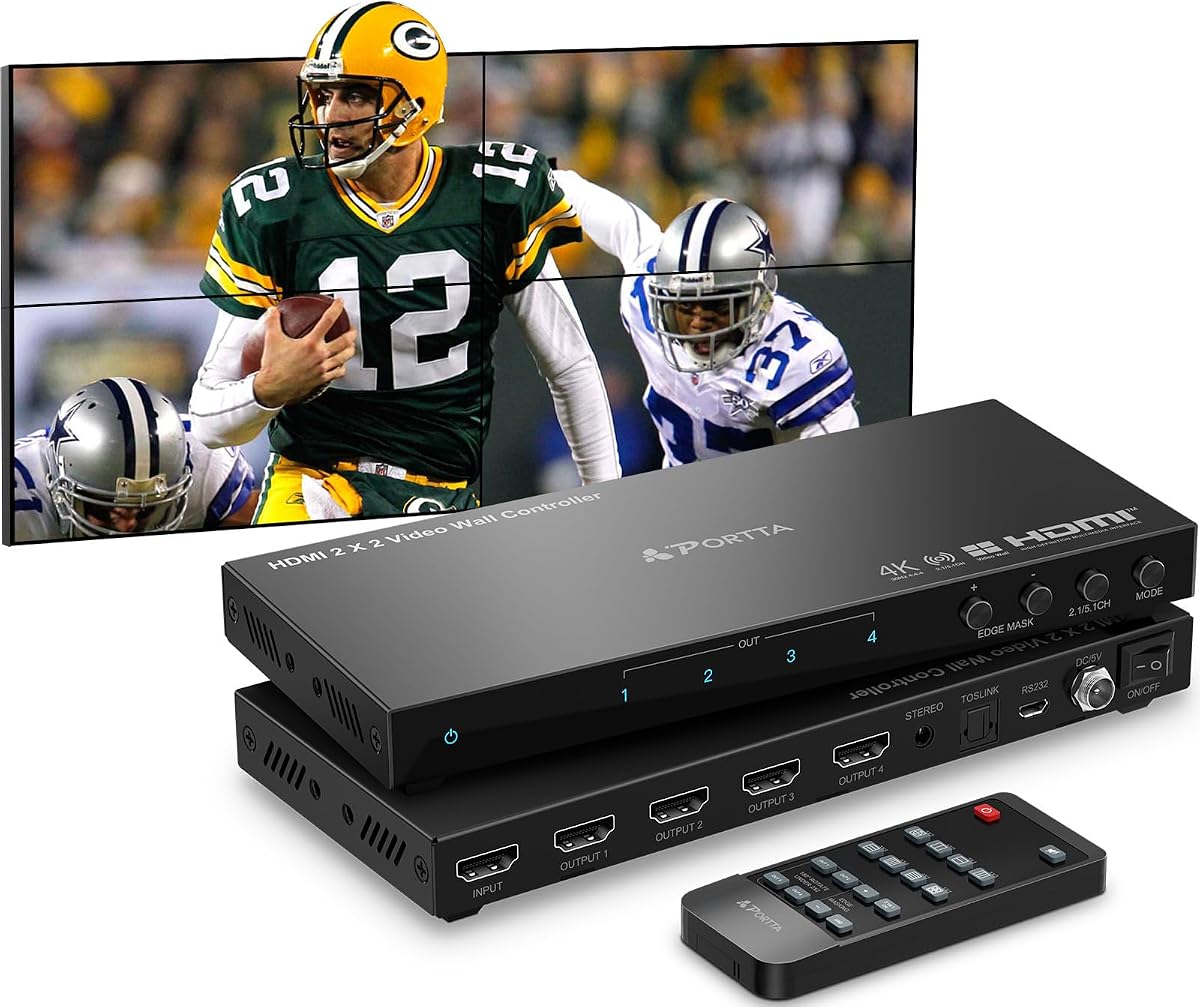
PORTTA's controller offers extensive splicing options with eleven display modes to suit diverse layouts. It supports 4K 30Hz inputs and includes edge masking for precise bezel alignment and polished visual presentation.
We may earn a commission when you buy through this link, at no additional cost to you.
Audio extraction via Toslink and 3.5mm ensures flexible sound routing. Portrait display support allows vertical setups in 1×2, 1×3, and 1×4 modes, adding creative flexibility for signage and informational displays.
Although outputs are limited to 1080p and HDR is unsupported, the controller delivers reliable performance for most commercial signage and advertising needs. Its ease of use makes it accessible for non-technical users.
This model is ideal for businesses needing adaptable display configurations without complex setup. It balances performance and affordability while providing the flexibility to create engaging and dynamic visual experiences.
Use portrait mode support to create vertical layouts perfect for retail signage and directory displays.
Edge masking adjusts output by eight pixels to correct distortion and eliminate bezel gaps seamlessly.
We may earn a commission when you buy through this link, at no additional cost to you.
OREI provides a versatile option for users needing both HDMI and USB-C inputs. With 4K@60Hz support and RS-232 control, this model serves well in professional settings requiring high-speed data and automation.
We may earn a commission when you buy through this link, at no additional cost to you.
180-degree rotation and optical audio extraction ensure display flexibility and sound quality. Bezel adjustment and EDID management optimize screen setup, ensuring consistent quality across all connected displays.
The fixed output resolution may be a limitation for ultra-high-resolution projects. However, for general business use, this controller delivers reliable performance and integrates easily with modern computing devices.
Businesses requiring dual input compatibility will find this controller valuable. Its combination of features supports complex setups while maintaining simplicity, making it suitable for diverse applications and environments.
Connect HDMI and USB-C sources simultaneously for maximum compatibility with modern and legacy equipment.
Use bezel adjustment and EDID management to ensure seamless alignment and consistent performance across displays.
We may earn a commission when you buy through this link, at no additional cost to you.
This model expands functionality with 4×4 matrix switching alongside video wall capabilities. It allows seamless switching between multiple sources and displays, making it ideal for larger installations requiring flexibility.
We may earn a commission when you buy through this link, at no additional cost to you.
Web control enables remote management via any browser, while advanced EDID ensures consistent resolution across all outputs. Support for Dolby TrueHD and DTS-HD ensures high-fidelity audio routing for immersive experiences.
The added complexity may require technical expertise for full utilization. However, for enterprises needing multiple sources and displays, this controller delivers unmatched flexibility and reliability for professional-grade setups.
Larger organizations and AV integrators should consider this matrix-based model. It combines video wall functionality with robust switching, offering comprehensive control for complex multi-source environments.
Switch between four HDMI sources and distribute to four displays seamlessly for dynamic content management.
Control settings and switching remotely via any web browser for convenient centralized management.
We may earn a commission when you buy through this link, at no additional cost to you.
ISEEVY stands out by supporting native 4K outputs on all four HDMI ports. With 4K60 input and USB-C compatibility, this model is ideal for users requiring high-resolution clarity across multiple displays.
We may earn a commission when you buy through this link, at no additional cost to you.
Its plug-and-play design simplifies installation, and 24×7 stable operation ensures reliability for continuous use. Rotation capabilities allow flexible mounting orientations, ensuring correct display orientation regardless of physical placement.
While display modes are fewer than competitors, the focus on high-resolution output justifies the choice. This controller suits environments prioritizing image quality over advanced configuration options.
Professionals needing crisp 4K visuals should prioritize this controller. It delivers consistent performance and supports modern input formats, making it a robust choice for high-fidelity display needs.
Support native 4K outputs on all ports to maximize image clarity across your entire video wall.
Designed for 24×7 stable operation ensuring reliability for continuous use in professional environments.
We may earn a commission when you buy through this link, at no additional cost to you.
This controller supports USB media playback and auto-display functionality, allowing direct video and image playback from USB drives. With 4K60 input and HDMI 2.0, it delivers high-resolution visuals without needing external media players.
We may earn a commission when you buy through this link, at no additional cost to you.
Built-in audio outputs ensure sound synchronization, while image adjustments for brightness and contrast allow precise tuning. IR extension supports long-distance remote control, making it user-friendly for public displays.
The lack of network interfaces limits remote management options. However, for standalone playback setups, this model offers unmatched convenience and high-quality visual performance with minimal hardware requirements.
Retailers and event organizers will benefit from direct USB playback. This controller simplifies content management and delivers excellent visual quality, making it ideal for advertising and promotional displays.
Play video, images, and audio directly from USB drives without requiring a connected computer.
Adjust brightness, sharpness, and color temperature to ensure content looks optimal in various lighting environments.
We may earn a commission when you buy through this link, at no additional cost to you.
This ISEEVY model supports up to six HDMI outputs, enabling larger video walls beyond standard four-screen setups. With 4K60 input and 2X3 or 3X2 modes, it accommodates expansive configurations for large venues.
We may earn a commission when you buy through this link, at no additional cost to you.
Plug-and-play design simplifies installation, while 180-degree rotation ensures flexibility for unusual mounting arrangements. USB-C and HDMI inputs provide broad compatibility with diverse devices and content sources.
The increased output count and higher cost may exceed needs for smaller setups. However, for large-scale applications requiring multiple displays, this controller delivers unmatched scalability and performance.
Enterprises needing extensive video walls should consider this model. It supports six displays seamlessly, delivering high-resolution visuals and robust connectivity for complex professional installations.
Support up to six HDMI outputs for larger video walls in stadiums, arenas, and expansive commercial spaces.
Use 2X3 and 3X2 splicing modes to create custom display layouts suited to unique architectural requirements.
We may earn a commission when you buy through this link, at no additional cost to you.
Selecting the right HDMI Video Wall Controller requires evaluating key factors that impact performance, compatibility, and ease of use. This guide outlines essential considerations to help you make an informed decision based on your specific display needs.
Ensure the controller supports your source resolution to avoid quality loss. Some models accept 4K inputs but output 1080p, while others maintain full 4K across all ports. Matching resolution capabilities to your displays is crucial for optimal visual quality.
Look for models supporting 4K60Hz input if you need smooth motion or high-detail content.
Controllers offer various splicing modes such as 2×2, 1×4, or 4×1 layouts. Choose a unit with modes that match your screen arrangement. Advanced models provide more modes for flexible configurations.
Verify that the controller includes bezel adjustment or edge masking to minimize gaps between screens.
Consider input types like HDMI, USB-C, or DVI depending on your source devices. RS-232, IR remote, or web control interfaces determine how easily you can manage the controller remotely.
USB-C support adds modern compatibility for laptops and media players without needing extra adapters.
Audio output options ensure sound synchronization with video. Look for optical SPDIF, 3.5mm analog, or HDMI audio extraction depending on your sound system setup.
Built-in audio outputs eliminate the need for external splitters and simplify installation.
180-degree rotation allows flexible mounting, especially for displays installed upside down. Edge masking corrects distortion at screen borders for a seamless appearance.
These features are essential for achieving a professional finish on any video wall.
Check warranty terms and customer support availability. Models offering extended warranties and technical support provide peace of mind for critical installations.
Consider brands with proven reliability and positive user feedback in professional settings.
Dual voltage power supplies support international use without adapters. Plug-and-play designs reduce setup complexity and minimize downtime.
Ensure physical dimensions and mounting options fit your installation space.
Budget controllers offer basic functionality for simple displays, while premium models support advanced features like network control or matrix switching.
Invest in features that align with your specific needs to avoid unnecessary costs.
Start by connecting your source device via HDMI or USB-C to the input port. Connect all display screens to the HDMI output ports, ensuring proper power supply to both the controller and displays.
Use the included remote or web interface to select your preferred display mode. Adjust edge masking or rotation settings if screens have visible bezels or are mounted in unconventional orientations.
Keep firmware updated if applicable, and ensure ventilation to prevent overheating. Regularly inspect cables for wear and clean the controller with a dry cloth to maintain reliable performance.
An HDMI Video Wall Controller is a device that takes one or more input signals and distributes them across multiple displays. It enables seamless integration of several screens into a single large visual display for professional or commercial use.
Many controllers accept 4K inputs but may output at lower resolutions like 1080p. Check each model's specifications to confirm if it supports full 4K on all outputs. If you need true 4K on all screens, choose a controller that explicitly states 4K output support.
Some models include USB-C input support for modern laptops and media devices. This feature simplifies connections without needing HDMI adapters. Confirm USB-C availability in the product specs before purchasing.
Display modes are typically controlled via IR remote, RS-232, or a web interface. Use the remote to cycle through modes or access settings via a connected PC. Refer to the user manual for mode-specific instructions.
Yes, most controllers offer audio extraction via optical SPDIF or analog 3.5mm outputs. This allows you to route sound to external speakers independently of the HDMI display. Check audio port availability in the product description.
Most units have compact designs suitable for mounting behind screens or inside equipment racks. Check dimensions and mounting options to ensure fit. Use mounting ears if included for secure installation.
Yes, gaming consoles connect via HDMI and work with these controllers. Ensure the controller supports the console's resolution and refresh rate. Some models may limit output to 1080p for gaming.
Most models work plug-and-play without additional software. Advanced features may require a PC client or web interface for configuration. Check product documentation for any software requirements.
Selecting the right HDMI Video Wall Controller depends on your specific needs and budget. From affordable budget-friendly models to premium units with advanced web control, there is an option for every scenario.
Prioritize features like resolution support, display modes, and connectivity options that match your installation. Consider long-term reliability and support to ensure lasting performance.
Verify current pricing and availability before purchasing, as these details may change. Choose a model that balances performance with ease of use to create stunning and effective video displays.