
GIGABYTE B550M K
4.4Editor score
Affordable AM4 Socket
PCIe 4.0 Slot
Dual M.2 Slots
Discover the top motherboards for video editing optimized for performance and stability across AMD platforms.
Video editing requires a powerful system to handle intensive rendering and playback tasks efficiently. The motherboard acts as the backbone connecting all critical components like the CPU, GPU, and storage. Choosing the right one ensures smooth workflows and future-proofing for your creative projects.
We compared ten top-rated motherboards focusing on key features like socket compatibility, PCIe lanes, and memory support. Our analysis evaluates thermal design, connectivity options, and power delivery to determine which boards excel in demanding editing environments. This list covers various price points and form factors.
Each pick highlights specific strengths suited for different editing needs and budgets. You will find options for budget builds, high-end workstations, and compact systems. Please note that availability and pricing can change rapidly so verify details before purchasing to ensure you get the best current offer.
4.4Editor score

4.6Editor score

4.0Editor score
This side-by-side comparison highlights the key specifications and strengths of each motherboard to help you find the perfect match for your video editing workstation needs and budget constraints.



The ASUS ROG Strix B550-F Gaming WiFi II stands out as the top choice for video editing due to its balanced feature set and high ratings. It supports AMD Ryzen 5000 series processors and offers PCIe 4.0 readiness which is crucial for fast data transfer speeds. Its robust power solution ensures stability during long rendering sessions making it a reliable workstation component.
We may earn a commission when you buy through this link, at no additional cost to you.
Key strengths include the 12+2 teamed power stages that deliver steady power to high core count CPUs. The onboard WiFi 6E and Intel 2.5 Gb Ethernet provide fast and reliable networking for transferring large video files. Additionally the dual M.2 slots and USB 3.2 Gen 2 Type-C ports support high-speed storage solutions needed for 4K or 8K editing workflows.
Honest trade-offs involve its DDR4 memory support which limits future upgrade paths compared to DDR5 boards. However for many editors the speed and capacity of DDR4 kits are still sufficient for high resolutions tasks. The price point is also higher than budget options but the performance and reliability justify the investment for professionals.
This motherboard is ideal for editors using AMD Ryzen 5000 CPUs who need a stable and fast platform. Whether you are working on short form content or feature films this board handles the load efficiently. We highly recommend it for those seeking a premium ATX board with excellent connectivity and power design.
The 12+2 power stages ensure consistent power flow to the CPU preventing throttling during intensive rendering tasks.
WiFi 6E and 2.5Gb LAN allow for fast file transfers and seamless network storage access.
We may earn a commission when you buy through this link, at no additional cost to you.
The GIGABYTE B850 AORUS Elite WIFI7 is an excellent choice for editors looking to build a future-proof system with the latest AMD AM5 platform. It supports Ryzen 9000 8000 and 7000 series processors offering a wide range of CPU options for different budgets. The inclusion of DDR5 and PCIe 5.0 ensures that your system will remain relevant as software and hardware standards evolve.
We may earn a commission when you buy through this link, at no additional cost to you.
Its key strengths lie in the 14+2+2 power phase design which provides ample power for high-end CPUs. The 3x M.2 slots and PCIe 5.0 support enable ultra-fast storage configurations essential for smooth playback of high bitrate footage. WiFi 7 connectivity offers lower latency and faster speeds which is beneficial for cloud editing and remote collaboration.
One trade-off is that the AM5 platform is newer and might experience occasional BIOS or driver updates as it matures. The cost is also higher than established AM4 options which could be a consideration for budget-conscious builders. Despite this the long term value of DDR5 and PCIe 5.0 makes it a smart investment for serious creators.
We recommend this board for editors planning to use Ryzen 7000 or newer CPUs who want the latest technology. It is perfect for those who need high bandwidth for multiple fast storage drives. If you prioritize longevity and cutting-edge features this motherboard delivers exceptional performance and versatility.
Supporting DDR5 and PCIe 5.0 ensures your system keeps up with future software and hardware demands.
VRM and M.2 thermal guards keep components cool under heavy loads ensuring sustained performance.
We may earn a commission when you buy through this link, at no additional cost to you.
The GIGABYTE B650 AORUS Elite AX offers a compelling mix of performance and value for video editors on the AM5 platform. It supports the latest Ryzen processors and provides DDR5 memory support which is vital for high bandwidth needs in modern editing software. The board is designed with robust power phases that can handle multi-core rendering tasks without overheating.
We may earn a commission when you buy through this link, at no additional cost to you.
Key strengths include the 14+2+1 power phase design that ensures stable power delivery. The PCIe 5.0 M.2 slot allows for the fastest NVMe SSDs currently available which speeds up project loading and rendering. Connectivity is comprehensive with USB-C 3.2 Gen 2 and WiFi 6E ensuring you can transfer files quickly and connect to modern displays easily.
A trade-off is that only one M.2 slot supports PCIe 5.0 which might limit your storage speed if you plan to add multiple fast drives. However for most editors one ultra-fast drive is sufficient for the active project drive. The AM5 platform cost is also a factor but the performance benefits are significant.
This board is a great choice for editors upgrading to Ryzen 7000 or 9000 series CPUs who want DDR5 performance. It suits those who need a reliable ATX board with advanced connectivity options. We find it ideal for mid-range builds that aim for high performance without the premium price tag of top-tier boards.
Twin 14+2+1 phases with 70A power stages deliver efficient power to demanding CPUs.
M.2 Thermal Guard and heatsinks prevent thermal throttling during long editing sessions.
We may earn a commission when you buy through this link, at no additional cost to you.
The ASUS Prime B550M-A WiFi II is an excellent option for editors who need a smaller footprint without sacrificing key features. It supports AMD Ryzen 3000 and 5000 series CPUs and offers PCIe 4.0 which is essential for fast graphics cards and storage. The compact design is perfect for builds where space is a constraint but performance is still a priority.
We may earn a commission when you buy through this link, at no additional cost to you.
Key strengths include the WiFi 6 connectivity and USB 3.2 Gen 2 Type-C port which enhance workflow efficiency. It also supports ECC Memory which adds stability for long rendering jobs by correcting memory errors. The VRM heatsink and hybrid fan headers ensure the system stays cool even in a smaller chassis with less airflow.
A trade-off is the limited expansion slots due to the Micro ATX size which might restrict adding multiple PCIe cards. Also DDR4 memory limits future upgrades compared to DDR5 boards. However for many editing tasks the performance gap is minimal and the price and size benefits are significant.
We recommend this board for editors building compact workstations or those who need ECC memory support on a budget. It is suitable for 1080p to 4K editing where space efficiency matters. If you want a reliable and small motherboard that still packs modern connectivity this is a top pick.
Micro ATX form factor saves space while maintaining essential PCIe 4.0 performance.
ECC memory support and comprehensive protection features ensure system reliability during critical work.
We may earn a commission when you buy through this link, at no additional cost to you.
The GIGABYTE B550M K is the top budget choice for video editing providing essential features at a very accessible price. It supports AMD Ryzen 5000 4000 and 3000 series processors allowing for a capable editing build without breaking the bank. The inclusion of PCIe 4.0 and dual M.2 slots means you can still benefit from fast storage speeds.
We may earn a commission when you buy through this link, at no additional cost to you.
Key strengths are the digital 3+3 VRM design that ensures steady power delivery for Ryzen CPUs and the chipset heatsink that aids cooling. Dual M.2 slots allow you to separate OS and project storage for better workflow organization. The board also supports DDR4 memory which remains a cost-effective option for high capacity kits.
Trade-offs include a simpler power design and fewer connectivity options compared to higher-end boards. It lacks WiFi and has fewer USB ports which might require additional accessories. However for a dedicated workstation PC these limitations are acceptable given the significant savings on the motherboard.
We recommend this board for entry-level editors or those building a secondary machine. It is perfect for budget conscious users who need a reliable platform for 1080p and basic 4K editing. If you want to maximize performance per dollar this board offers excellent value and solid performance.
Delivers PCIe 4.0 and dual M.2 at a price that fits tight budgets.
Focuses on key specs for editors like fast storage and solid CPU support.
We may earn a commission when you buy through this link, at no additional cost to you.
The GIGABYTE TRX50 AERO D is the ultimate board for professional editors who need extreme performance and bandwidth. It supports AMD Ryzen Threadripper PRO 7000 series processors providing up to 96 cores for massive parallel rendering. The E-ATX form factor accommodates high end hardware and the 16+8+4 power phase design ensures stability under full load.
We may earn a commission when you buy through this link, at no additional cost to you.
Key strengths include the 10GbE Ethernet and USB4 Type-C ports which enable blazing fast data transfer to external storage and networks. The board supports up to four DDR5 R-DIMMs with massive capacity for large project files. With PCIe 5.0 support and multiple slots you can connect multiple high-end GPUs and NVMe drives simultaneously.
Trade-offs are significant in terms of cost and the need for specialized components like Threadripper CPUs and large cooling solutions. It is overkill for standard 4K editing and better suited for 8K or VFX work. The price is high but the performance ceiling is unmatched for professional workloads.
We recommend this board for enterprise studios and professional editors working with complex 8K or multi-camera projects. If you need the highest core counts and fastest networking this board delivers unmatched capability. It is a premium investment for those who demand the best tools available.
16+8+4 phase VRM supports high core count Threadripper PRO CPUs effortlessly.
10GbE and USB4 provide the bandwidth needed for enterprise storage solutions.
We may earn a commission when you buy through this link, at no additional cost to you.
The ASUS ROG Strix X870E-E Gaming WiFi is a top tier AM5 motherboard designed for power users and editors who demand maximum storage and connectivity. It supports Ryzen 9000 8000 and 7000 series CPUs with a robust 18+2+2 power stage design. The board includes five M.2 slots allowing for extensive fast storage configurations without extra cards.
We may earn a commission when you buy through this link, at no additional cost to you.
Key strengths include the AI OCing and Networking features that simplify tuning and optimize performance automatically. Dual USB4 Type-C ports and WiFi 7 provide top tier connectivity speeds for modern peripherals and networks. The integrated thermal design with massive heatsinks keeps temperatures low even when all storage and CPU are under heavy load.
A trade-off is the premium price and high power requirements which might be excessive for casual users. The board is also quite large and requires a spacious case for proper airflow. However for editors who need multiple fast NVMe drives and maximum performance these costs are justified by the capabilities.
We recommend this board for editors who need multiple fast storage drives and want the latest tech. It is ideal for high-end builds where budget is secondary to performance and flexibility. If you want the best features AM5 has to offer this board stands out as a leader.
Five onboard M.2 slots allow for a vast fast storage array in one board.
AI OCing and Networking features make tuning and connectivity effortless for pros.
We may earn a commission when you buy through this link, at no additional cost to you.
The ASUS TUF Gaming B550-PLUS WiFi II is a reliable and durable option for video editing workstations. It supports AMD Ryzen 3000 and 5000 series CPUs with a robust 8+2 DrMOS power stage design. The board is built with military grade components that ensure long-term reliability which is crucial for professional work environments.
We may earn a commission when you buy through this link, at no additional cost to you.
Key strengths include the 2.5Gb LAN and WiFi 6 which provide fast and stable network connectivity. Dual M.2 slots support PCIe 4.0 allowing for fast SSD storage configurations. HDMI 2.1 support ensures compatibility with modern monitors and TVs allowing for high resolution output without adapters.
Trade-offs involve the DDR4 memory limitation and fewer premium features compared to higher-end models. The design is utilitarian and focuses on function over flashy aesthetics. However for those who prioritize stability and reliability the TUF build quality offers great peace of mind.
We recommend this board for editors who want a solid and reliable build without excessive features. It suits those working on a budget who still need good connectivity and power. If you value durability and performance this motherboard is an excellent choice for daily editing tasks.
TUF components and military grade testing ensure long-term reliability.
2.5Gb LAN and WiFi 6 provide excellent connectivity options for file transfer.
We may earn a commission when you buy through this link, at no additional cost to you.
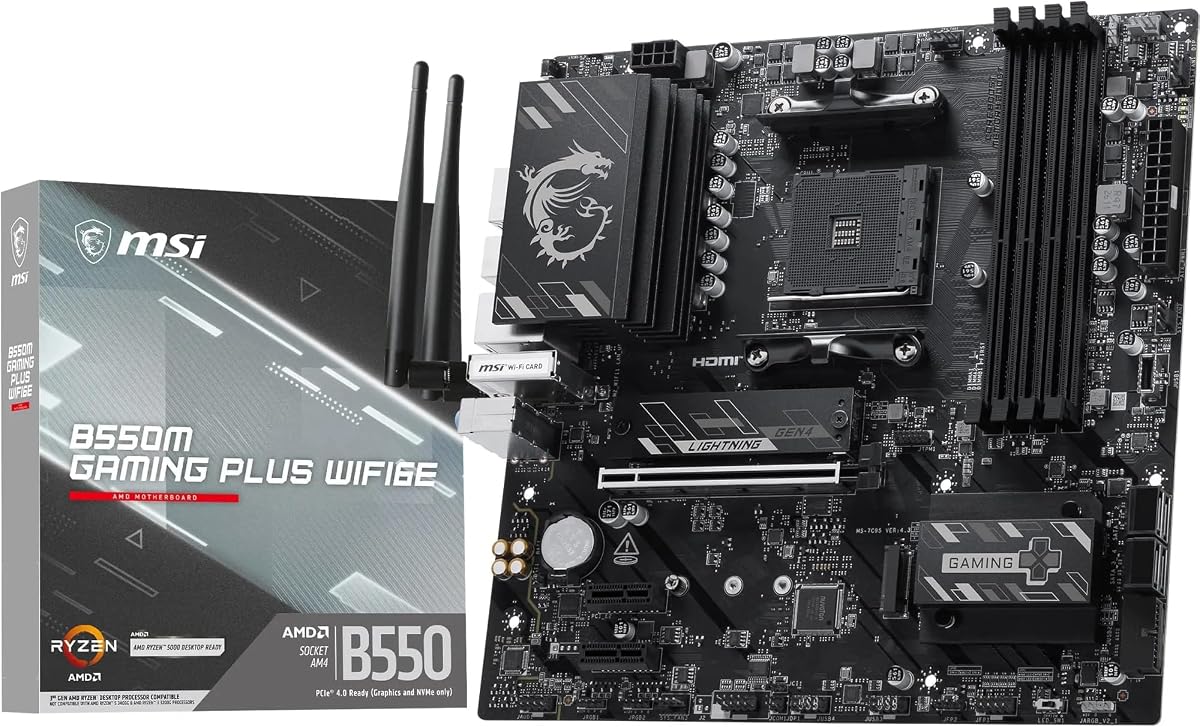
The MSI B550M Gaming Plus WIFI6E is a top-rated Micro-ATX motherboard that balances performance and value well for video editing. It supports AMD Ryzen 5000 series CPUs with Core Boost technology that enhances stability and performance. The board allows for high-speed DDR4 memory overclocking which benefits memory-intensive editing applications.
We may earn a commission when you buy through this link, at no additional cost to you.
Key strengths include the dual M.2 connectors with Gen4 and Gen3 support providing fast storage options. Wi-Fi 6E and Bluetooth 5.3 offer modern wireless connectivity and the Steel Armor protects your GPU during transport. The Extended Heatsink ensures that the VRM stays cool under heavy workloads.
Trade-offs include the 1Gbps LAN which is slower than the 2.5Gb options on other boards. The compact size also limits expansion slots for additional PCIe cards. However for most editing needs these limitations are acceptable given the strong core performance and storage speeds.
We recommend this board for editors needing a compact build with good storage and wireless features. It is perfect for those who want solid performance without a large footprint. If you value memory speeds and modern connectivity this board offers a high quality experience.
Memory Boost allows for high-speed DDR4 overclocking to boost system performance.
Gen4 and Gen3 M.2 slots provide excellent storage speeds for project files.
We may earn a commission when you buy through this link, at no additional cost to you.
The ASUS TUF Gaming B850-PLUS WiFi brings the reliable TUF quality to the latest AM5 platform making it a great choice for modern editing setups. It supports Ryzen 9000 8000 and 7000 series CPUs with a powerful 14+2+1 80A power stage design. The board is built for longevity with durable components that withstand the rigors of professional work.
We may earn a commission when you buy through this link, at no additional cost to you.
Key strengths include the DDR5 support and PCIe 5.0 slot which future proof your build for upcoming software. Three M.2 slots offer flexible storage options and Wi-Fi 7 ensures the fastest wireless networking available. USB 20Gbps Type-C ports enable fast data transfer to external drives.
Trade-offs involve the higher cost of DDR5 and AM5 components as well as the need for a larger case. The power draw is also higher than AM4 boards which requires a quality power supply. However the performance gains and new features make it a strong contender for new builds.
We recommend this board for editors building a new system on the AM5 platform who value durability. It is ideal for those who want reliable features like PCIe 5.0 and DDR5 without the premium ROG price. If you prioritize stability and future tech this board is a solid investment.
PCIe 5.0 and DDR5 support ensure compatibility with next-gen hardware and software.
Military grade testing and durable components ensure long-term reliability for editors.
We may earn a commission when you buy through this link, at no additional cost to you.
Selecting the right motherboard requires understanding key factors that impact performance and compatibility for your editing needs.
The CPU socket determines which processors your motherboard supports. AM4 is mature and cost-effective for Ryzen 5000 while AM5 supports newer Ryzen 7000 8000 and 9000 series with DDR5 support. Choose a platform that aligns with your CPU budget and future upgrade plans.
Ensure the socket matches your preferred CPU brand and generation to avoid compatibility issues.
PCIe lanes control data transfer speeds between your CPU GPU and storage. PCIe 4.0 and 5.0 offer faster speeds essential for high-end GPUs and NVMe drives. More lanes allow for multiple high-speed devices without bottlenecking your system.
Look for boards with at least one PCIe 4.0 or 5.0 x16 slot for your GPU and multiple M.2 slots for storage.
Video editing benefits from high RAM capacity and speed. DDR5 offers higher bandwidth than DDR4 which can improve rendering and multitasking performance. Check the maximum supported capacity to ensure you can install enough memory for large projects.
Prioritize boards with four DIMM slots and support for high speeds to maximize system efficiency.
A robust VRM design ensures stable power delivery to your CPU during intensive rendering tasks. Boards with more power stages and higher amperage ratings handle higher core count CPUs better. This stability prevents throttling and ensures consistent performance.
Choose a board with a strong VRM design especially if you plan to use high-end Ryzen CPUs.
Fast storage is crucial for editing large video files. Multiple M.2 slots with PCIe support allow you to install fast NVMe SSDs for OS and active projects. More slots give you flexibility to expand storage without adding adapter cards.
Verify the board has enough M.2 slots to meet your workflow needs and speed requirements.
Network speed affects file transfers to shared storage or cloud services. Look for boards with 2.5Gb Ethernet or 10GbE for faster transfers. Wi-Fi 6 or 6E provides reliable wireless options and USB-C ports support modern monitors and peripherals.
Ensure the board offers fast Ethernet or Wi-Fi to keep your workflow efficient.
Cooling solutions for the VRM and M.2 slots prevent thermal throttling during long rendering sessions. Heatsinks and thermal pads dissipate heat effectively ensuring stable performance under load. Good thermal design is vital for high-end builds.
Check for M.2 heatsinks and robust VRM cooling to maintain system reliability.
Motherboard sizes include ATX Micro ATX and E-ATX. ATX offers more expansion slots and better cooling while Micro ATX saves space. E-ATX is for workstation builds with maximum hardware support. Choose a size that fits your case and workflow needs.
Match the motherboard size with your case to ensure proper fit and airflow.
Install the motherboard in a well-ventilated case to ensure airflow reaches the VRM and M.2 heatsinks. Proper cable management helps keep air flowing freely through the chassis for better cooling.
Update the BIOS regularly to ensure compatibility with new CPU models and fix potential bugs. Use the BIOS Flashback feature if available to update without needing a CPU installed.
Monitor system temperatures using software tools to ensure your cooling solution is performing well. Clean dust from heatsinks and fans every few months to prevent overheating during long editing sessions.
For 4K editing the ASUS ROG Strix B550-F Gaming WiFi II is the top choice due to its PCIe 4.0 support and robust power delivery. It balances performance and cost effectively for Ryzen 5000 CPUs. If you prefer AM5 the GIGABYTE B650 AORUS Elite AX is an excellent alternative.
PCIe 5.0 is not strictly necessary for 4K editing but it future proofs your build for future GPUs and storage. Most current GPUs do not saturate PCIe 4.0 bandwidth so a good PCIe 4.0 board is sufficient for now. Focus on M.2 slots and CPU power instead.
DDR5 offers higher bandwidth which can help with large projects and multitasking. It is worth it if you are building a new system with AM5 CPUs. For budget builds DDR4 still delivers great performance and is more cost-effective.
A VRM design with at least 12 power stages is suitable for Ryzen 9 CPUs to ensure stable power. Look for boards with high-quality chokes and capacitors to prevent overheating. This ensures your CPU performs at its best during long renders.
Two to three M.2 slots are ideal for separating OS active project and storage files. This setup improves workflow efficiency and speeds up data access. Boards with PCIe 4.0 or 5.0 M.2 slots offer the best performance.
ATX boards offer better cooling and more expansion slots which can benefit complex builds. Micro ATX is fine if space is limited and you do not need many PCIe cards. Choose based on your case size and component needs.
The ASUS ROG Strix B550-F Gaming WiFi II stands out as the overall best choice for balancing performance and value. The GIGABYTE B550M K offers great budget options while the TRX50 AERO D provides premium workstation power.
When choosing a board prioritize features like PCIe 4.0 support strong power delivery and fast storage connectivity. These elements directly impact rendering speed and workflow efficiency in video editing tasks.
Remember to check current availability and compatibility with your chosen CPU and RAM. Prices and stock change so verify the latest details before making your final purchase decision.