
1/2'' Flow Hall Sensor
4.7Editor score
1-30L/min flow range
NPT thread compatibility
Compact lightweight design
Arduino flow meters are essential components for any project requiring precise liquid measurement. Whether you are building a smart irrigation system or monitoring home water usage, selecting the right sensor ensures reliable data and long-term performance in your setup.
We evaluated ten top-rated models based on flow range, build quality, and compatibility with popular microcontrollers like Arduino and Raspberry Pi. Our analysis focuses on real-world performance, ease of installation, and how well each sensor handles various water pressures and temperatures.
Each pick highlights specific strengths to help you match a sensor to your project needs. Keep in mind that stock levels and pricing fluctuate frequently, so check current availability before purchasing to ensure you get the best value for your specific application requirements.
4.7Editor score

5.0Editor score

4.9Editor score
As an Amazon Associate we earn from qualifying purchases.
The following table provides a side-by-side comparison of all ten selected flow meters. It outlines key specifications such as flow range, thread size, and voltage requirements to help you quickly identify the model that best fits your technical constraints and project goals.


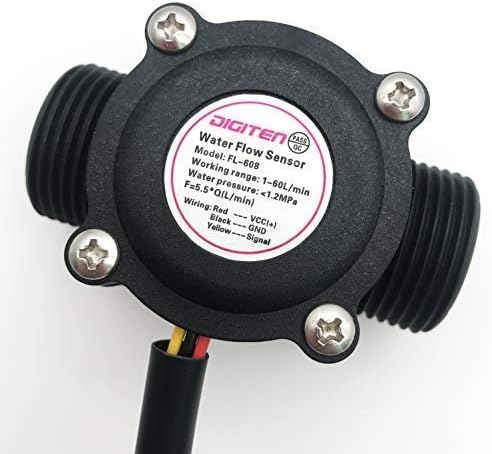
This DIGITEN model stands out as the most versatile option for larger-scale projects requiring significant water throughput. With a perfect five-star rating, it delivers exceptional reliability for systems like reverse osmosis filters or industrial cooling loops where accuracy and durability are paramount.
We may earn a commission when you buy through this link, at no additional cost to you.
Its impressive flow range of five to one hundred and fifty liters per minute makes it ideal for scenarios where smaller sensors would bottleneck performance. The all-ROHS compliant materials ensure safety for potable water applications, while the strong pressure resistance up to 1.75 Mpa guarantees stability under stress.
While the G1.5 inch thread size is larger than standard quarter-inch or half-inch options, it ensures robust connections for high-volume pipes. You may need sealant tape if adapting to NPT threads, but this minor setup detail is a worthy trade-off for its superior performance.
Choose this sensor if your project demands high flow capacity and long-term reliability. It is the top recommendation for users needing a premium Arduino flow meter that can handle demanding environments without compromising on data accuracy or component safety.
The wide flow range allows this sensor to accurately measure fast-moving streams that would overwhelm standard low-flow models.
Compliance with ROHS standards ensures the sensor is safe for contact with drinking water and food-grade applications.
We may earn a commission when you buy through this link, at no additional cost to you.
This compact flow sensor offers an excellent entry point for hobbyists looking to add water monitoring to their Arduino projects. Its strong 4.7 rating reflects consistent performance in home automation tasks like monitoring water heaters or smart irrigation systems effectively.
We may earn a commission when you buy through this link, at no additional cost to you.
The built-in magnetic hall effect sensor ensures that the electrical components remain dry and protected from water damage. Installation is straightforward thanks to the NPT thread, which fits many standard household plumbing setups without needing extra adapters or complex modifications.
It is critical to install the sensor in the correct flow direction to ensure a signal is produced. Users should also be aware that this specific model does not come with a pre-attached cable, so you may need to solder wires to connect it to your microcontroller.
If you are working on a budget and need a reliable sensor for standard flow rates, this is the best value option. It provides the core functionality required for most DIY water metering tasks without the higher cost of premium industrial models.
The sealed design keeps the hall effect sensor safe from moisture, extending the lifespan of the device in wet conditions.
Direct NPT threading simplifies installation into standard pipes, reducing the need for additional plumbing adapters.
We may earn a commission when you buy through this link, at no additional cost to you.
The DEVMO sensor is highly rated for its robust electrical characteristics and suitability for water cooling systems. With a 4.9 rating, it is a favorite among enthusiasts who need precise flow detection to prevent overheating in high-performance computer builds or industrial fluid systems.
We may earn a commission when you buy through this link, at no additional cost to you.
Its high amplitude output voltage provides a clean signal that is easy for microcontrollers to detect, minimizing noise and errors in your readings. The electric strength rating ensures the unit can withstand significant electrical stress, making it durable for rigorous testing environments.
While it performs well in general flow metering, it is specifically highlighted for water testing and cooling applications. Users looking for a basic rain counter might find this level of performance unnecessary, but the added reliability is worth the investment for critical systems.
Select this sensor if you need a premium component with exceptional signal integrity for your Arduino project. It is the top choice for advanced users prioritizing electrical performance and long-term stability in demanding cooling or testing setups.
The high amplitude voltage ensures the microcontroller receives a strong signal, reducing the chance of false readings.
Designed with water cooling systems in mind, this model excels in applications where flow rate is critical for temperature control.
We may earn a commission when you buy through this link, at no additional cost to you.
This food-grade sensor is an excellent choice for projects involving beverages or drinking water where material safety is a concern. With a 4.1 rating, it provides adequate performance for light commercial applications like vending machines or campus smart card water dispensers.
We may earn a commission when you buy through this link, at no additional cost to you.
The construction uses materials that conform to ROHS standards, ensuring no harmful substances leach into the water stream. This makes it safe for use in water purifiers and fountains where water quality must meet specific health standards for consumers.
The wide working voltage range from five to twenty-four volts offers flexibility in power supply options for your Arduino setup. However, users should note that while functional, the build quality is more basic compared to higher-rated premium models available in the market.
Choose this model if you need a certified food-safe sensor for a budget-conscious project. It is a practical solution for low-pressure systems where the primary concern is compliance with safety standards rather than high-flow performance.
Using food-grade plastic makes this sensor suitable for any application where human consumption of the water is possible.
Supporting a wide range of input voltages simplifies integration with different power sources and controller boards.
We may earn a commission when you buy through this link, at no additional cost to you.
This transparent flow meter allows you to visually inspect the internal rotor condition, which is helpful for maintenance. Rated at 3.7, it is popular among hobbyists who want to see the mechanics of their sensor working in real-time within their water system.
We may earn a commission when you buy through this link, at no additional cost to you.
The valve body is made of transparent material to facilitate observation of water flow and rotor conditions. This transparency helps users quickly diagnose issues like blockages or slow rotation without disassembling the device from their plumbing setup.
Although it includes stainless steel beads in the impeller for wear resistance, the plastic body is not as robust as metal alternatives. Users in high-pressure or industrial environments might find the plastic more prone to wear over time compared to metal housing options.
If you are building an educational project or need to monitor flow visually, this model offers a unique advantage. It is a solid choice for low-pressure home use where the ability to see the water flow adds value to your monitoring setup.
The clear housing allows you to see the rotor spinning, providing immediate visual feedback on water flow activity.
Sold as a two-pack, this gives you a spare sensor for redundancy or multiple projects without extra shipping costs.
We may earn a commission when you buy through this link, at no additional cost to you.
This small sensor is specialized for low-flow applications where precision matters more than high volume. With a 4.2 rating, it is well-suited for connecting directly to hoses in gardens or small drip irrigation systems using microcontroller logic.
We may earn a commission when you buy through this link, at no additional cost to you.
The G1/4 inch connector allows you to attach it easily to standard hosepipes with an inner diameter of five to seven millimeters. This direct connection style eliminates the need for complex fittings, making installation quick for temporary setups.
The pressure limit is relatively low at 0.8 Mpa, so it is not designed for main water supply lines. However, for controlled flows like those in beverage dispensers or small water features, it performs reliably without exceeding its design parameters.
Opt for this model if your project involves small tubing and low flow rates. It provides the necessary sensitivity to detect minor changes in water movement where larger sensors might struggle to register accurate pulses.
The direct hosepipe connection simplifies setup for temporary or portable monitoring devices in gardens or small setups.
Its narrow range ensures high accuracy for slow-moving water, making it ideal for precise drip irrigation control.
We may earn a commission when you buy through this link, at no additional cost to you.
This Taidacent model is highly rated for its specific design for water heaters and dispensers. The perfect five-star rating indicates consistent satisfaction among users who need dependable flow detection for regulating heating elements in domestic appliances.
We may earn a commission when you buy through this link, at no additional cost to you.
The magnetic rotor rotates based on the flow rate, and the hall sensor outputs a corresponding pulse signal for feedback. This feedback loop allows controllers to determine water flow magnitude accurately and regulate operations efficiently to prevent overheating.
Its compact design makes it easy to install at the water inlet end of small units without taking up much space. While it is optimized for heaters, the standard G1/2 interface ensures it can adapt to other small-scale plumbing needs effectively.
Choose this sensor if you are building or repairing a water heater project with Arduino. It provides the specific feedback mechanism needed for regulation and maintains high reliability in temperature-sensitive environments.
The pulse signal feedback allows for immediate regulation of the system, ensuring safe operation during heating cycles.
Space-saving dimensions make it ideal for tight installation spots inside appliances or enclosures.
We may earn a commission when you buy through this link, at no additional cost to you.
This DIGITEN sensor offers significant convenience with a pre-attached 1.2-meter cable, saving you from soldering or extension cables. With a 4.8 rating, it is trusted by users who need to place the sensor in hard-to-reach pipes while keeping the Arduino controller in a dry area.
We may earn a commission when you buy through this link, at no additional cost to you.
The SM2.54 connector makes it easy to plug into compatible boards without custom wiring. This feature streamlines the installation process, reducing the risk of wiring errors and ensuring a secure connection for your flow meter system.
The waterproof build ensures the sensor can operate safely even in wet environments where condensation might occur. However, care should be taken with the connector end to ensure it remains dry to prevent electrical shorts in your circuit.
If you need flexibility in sensor placement, this model is the most practical choice. The extended cable allows for strategic positioning of the flow meter away from the main electronics, protecting your Arduino board from moisture.
The long cable allows you to locate the sensor remotely from the controller, protecting electronics from water exposure.
The standard connector simplifies wiring, making it easy to swap sensors or integrate into existing setups.
We may earn a commission when you buy through this link, at no additional cost to you.
This G3/8 sensor is ideal for applications requiring a compact form factor without sacrificing data accuracy. With a 4.5 rating, it serves well in reverse osmosis setups or drinking fountains where space is limited and flow rates are moderate.
We may earn a commission when you buy through this link, at no additional cost to you.
Its square wave output provides a clean signal that is simple for Arduino microcontrollers to read. The low voltage range makes it compatible with standard logic levels, simplifying the circuit design for hobbyists and professionals alike.
The small size allows it to fit into tight spaces where larger models would not install. While the pressure resistance is lower than high-flow models, it is sufficient for most domestic applications and small commercial systems.
Select this model if your project has space constraints and operates at lower pressures. It offers a reliable balance of size and performance for compact water metering tasks in constrained environments.
The G3/8 thread and small body allow installation in tight spaces where larger standard sensors cannot fit.
Square wave output simplifies signal processing, ensuring consistent data transfer to your microcontroller.
We may earn a commission when you buy through this link, at no additional cost to you.
This model is designed for high-flow applications requiring larger pipe connections. It supports flow rates up to 60 liters per minute and includes a long cable for flexible placement. While it has a 3.2 rating, its specifications make it a potential option for larger industrial or heavy-duty household setups.
We may earn a commission when you buy through this link, at no additional cost to you.
The G3/4 thread connects directly to standard large-diameter pipes, making it suitable for main water lines or industrial cooling systems. The extended cable allows for convenient installation away from the controller, protecting your electronics from the environment.
Users should note that while the technical specs are impressive, real-world feedback suggests some variability in performance. It is important to test the sensor thoroughly in your specific setup before relying on it for critical automation tasks.
Choose this sensor if you need to monitor larger pipes and flow rates beyond standard options. It offers the capacity for high-volume measurement but may require more attention during installation and testing to ensure consistent results.
The wide flow range allows this sensor to handle larger water volumes, making it suitable for main lines or industrial applications.
The included cable offers flexibility in sensor placement, helping you position the unit in safe or convenient locations.
We may earn a commission when you buy through this link, at no additional cost to you.
Selecting the right Arduino flow meter involves evaluating several technical factors. This guide breaks down the most important considerations to ensure you choose a sensor that fits your specific project requirements.
The flow rate range defines the minimum and maximum liters per minute your sensor can accurately measure. Choosing a sensor with a range that matches your expected flow is critical; if the flow is too low, it may not trigger the sensor, and if too high, it may damage the mechanism.
Always select a model where your typical usage falls comfortably in the middle of its rated range for optimal accuracy.
Thread size determines how the sensor connects to your plumbing system. Common sizes include G1/4, G1/2, and G3/8. Ensure you measure your pipe diameter and check if the sensor uses NPT or BSPT threads to avoid leakage.
If your pipe does not match the sensor's thread, use appropriate adapters or sealant tape to ensure a secure fit.
Arduino boards typically operate at 5V logic, but flow sensors may support ranges from 3.5V to 24V. Verify that your sensor's operating voltage is compatible with your microcontroller or power supply to avoid damage.
Sensors with wider voltage ranges offer more flexibility if you use different power sources for your project.
If your project involves drinking water or food, ensure the sensor materials are food-grade and ROHS compliant. This prevents toxic substances from leaching into the water stream and ensures regulatory compliance.
Standard industrial sensors may not be safe for human consumption and should be used only for technical fluids.
The pressure rating indicates the maximum water pressure the sensor can withstand without failing. High-pressure systems, such as main water lines, require sensors rated for higher MPa to prevent leaks or cracks.
For most household applications, a pressure rating of 0.8 MPa to 1.75 MPa is sufficient, but always check your system pressure.
Most Arduino flow sensors output a square wave pulse signal. This signal is easy for microcontrollers to read using interrupt pins. Ensure the signal type matches your programming capabilities to simplify your code.
A clear and strong output signal reduces noise and increases the accuracy of your flow measurements.
Consider how the sensor connects to your Arduino. Some models come with pre-attached cables or specific connectors like SM2.54, while others require soldering. Cables simplify installation but may be less durable than direct soldering.
Choose a model that matches your soldering skills and wiring needs for the easiest setup experience.
Established brands like DIGITEN or DEVMO often provide better quality control and customer support. Reading user reviews can help you identify sensors with consistent performance and durability.
While cheaper models exist, investing in a reputable brand often saves money in the long run by reducing replacement needs.
First, install the sensor on a straight section of pipe before any elbows or valves. Ensure the water flows in the direction indicated by the arrow on the sensor body to generate accurate pulses.
Next, connect the signal wire to a digital interrupt pin on your Arduino to detect pulses. Use the interrupt service routine to count pulses over a specific time window to calculate the flow rate in liters per minute.
Finally, protect the electronics from prolonged moisture by sealing connection points. Regularly check for debris that might block the rotor, especially if using the sensor with unfiltered water sources.
G1/2 and G3/4 refer to the size of the pipe thread. G1/2 fits pipes with a nominal diameter of about 15 millimeters, while G3/4 fits pipes of about 20 millimeters. Always match the sensor thread to your pipe size to ensure a proper fit.
Only if the sensor is explicitly marked as food-grade and made with non-toxic materials. Some sensors use industrial plastics that may contain harmful chemicals. Check the product description for ROHS compliance before using it for potable water.
Most hall effect flow meters are designed for water. Using other liquids with different viscosities may affect accuracy. Always check the sensor specifications to see if it supports other fluids before using it.
This could be due to installing the sensor in the wrong direction. Ensure the water flows from the inlet to the outlet as marked on the sensor. Also, check your wiring connections and ensure the interrupt pin is correctly set in your code.
Most sensors produce about 4.5 pulses per liter. Count the number of pulses in one second and divide by 4.5 to get liters per second, then multiply by 60 for liters per minute. Adjust the K-factor based on your specific sensor model.
Yes, but you need to use separate digital interrupt pins for each sensor. Since most Arduinos have limited hardware interrupts, using software interrupts is an alternative but may reduce accuracy at high flow rates.
Our top picks for November 2026 offer the best balance of performance and value. The DIGITEN G1.5 for leads for high-flow needs, while the 1/2'' Flow Hall Sensor remains the best budget option.
Prioritize flow range and pressure rating when selecting a sensor. Ensure the connection type matches your plumbing to avoid installation issues. Choosing the right sensor ensures your project runs smoothly without interruptions.
Prices and stock levels change frequently. Always verify the current availability and pricing on Amazon before placing your order. This ensures you get the best deal for your specific project requirements.