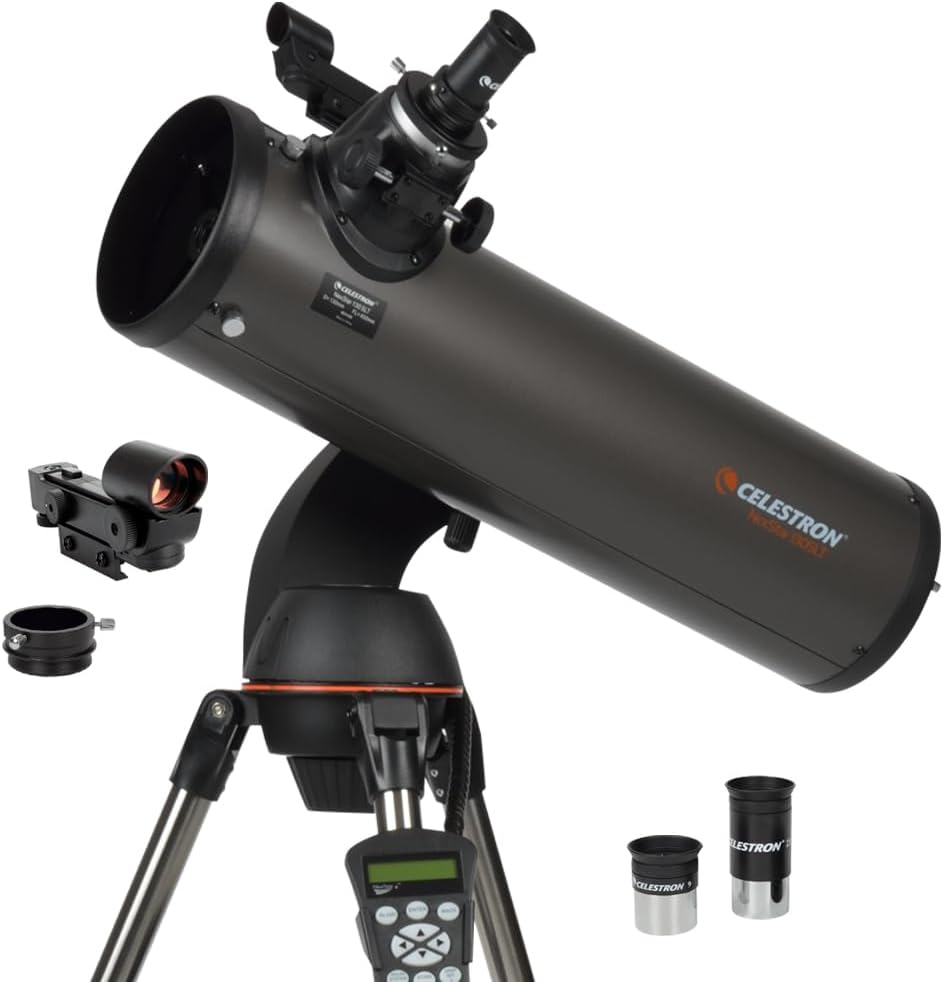
Celestron NexStar 130SLT Newtonian Reflector Telescope
4.4Editor score
Affordable computerized option
Compact and portable build
Includes free astronomy software
Choosing the right computerized telescope can transform your stargazing experience from a frustrating manual hunt into a seamless journey through the cosmos. These advanced instruments combine powerful optics with sophisticated motors and software to locate and track celestial objects automatically, making deep sky exploration accessible to everyone regardless of skill level.
To create this comprehensive guide, we analyzed a wide range of models based on optical performance, mount stability, ease of use, and overall value. We looked at how quickly each telescope aligns, how accurately it tracks objects across the sky, and what kind of views you can expect from different optical designs like reflectors and Schmidt-Cassegrains.
Each selection below highlights specific strengths such as portability, imaging capability, or advanced smart features that cater to different observing needs and budgets. Keep in mind that product availability and pricing can fluctuate frequently, so checking current stock and offers is always recommended before making your final decision to ensure you get the best deal available today.
4.4Editor score

4.3Editor score

4.4Editor score
As an Amazon Associate we earn from qualifying purchases.
The following table provides a side-by-side overview of the key specifications and features for each telescope on our list to help you quickly compare optical designs, aperture sizes, and unique capabilities.




The Celestron NexStar 8SE stands out as a top choice for serious amateur astronomers who want a balance between optical performance and automated convenience. With an 8-inch aperture, it offers the light-gathering power needed to see deep-sky objects clearly while maintaining a form factor that is manageable for most users.
We may earn a commission when you buy through this link, at no additional cost to you.
Its fully computerized GoTo mount allows you to select from a database of over 40,000 objects and have the telescope automatically slew to and track them. The SkyAlign technology simplifies the setup process significantly, allowing you to point at any three bright stars to calibrate the system in minutes rather than hours.
While the optical tube assembly is substantial, the integrated design makes it relatively portable compared to building a separate mount and tube. However, the weight means it is not ideal for hiking or casual backpacking trips, and you will want a sturdy surface or a vehicle to transport it to dark sky sites.
This telescope is perfect for adults who want to explore the night sky with precision and ease without spending countless hours on manual alignment. If you are looking for a reliable workhorse that can grow with your skills and handle both visual observation and basic imaging, this model delivers exceptional value.
The large 8-inch aperture captures significant light, revealing fine details on planets like Jupiter and Saturn while also bringing distant galaxies and nebulae into clear view.
The NexStar Plus hand control and SkyAlign technology ensure that you can start observing quickly, making it accessible even for beginners who do not know the night sky well.
We may earn a commission when you buy through this link, at no additional cost to you.
The Celestron NexStar 130SLT is an excellent entry point for adults looking to get into computerized astronomy without breaking the bank. Its 130mm Newtonian reflector design offers a solid amount of light gathering power, allowing you to see planetary details and deep-sky objects with clarity that exceeds many smaller scopes.
We may earn a commission when you buy through this link, at no additional cost to you.
Computerization is fully integrated into the system, offering a database of thousands of objects and reliable tracking capabilities. The compact design makes it easy to transport to dark sky sites, and the included Starry Night software adds significant value by helping you learn about the sky before you even step outside.
While the focal length is shorter than some premium models, which can limit extreme magnification on planets, it is perfectly adequate for most observational goals. The reflector optics may require occasional collimation to maintain peak performance, but this is a standard maintenance task for Newtonian designs and is easy to learn.
This telescope is ideal for beginners or families who want a high-tech experience at an accessible price. It balances cost, performance, and portability in a way that makes it a standout budget option in the computerized telescope market.
Priced significantly lower than many competitors, this telescope offers advanced computerized features and decent optical performance that make it a great first choice for new enthusiasts.
The lightweight and compact nature of the optical tube assembly means you can easily carry it to parks or camping trips without needing heavy-duty support equipment.
We may earn a commission when you buy through this link, at no additional cost to you.
The Odyssey PRO by UNISTELLAR represents a radical departure from traditional telescopes by integrating advanced digital imaging and automation directly into the optical tube. It allows you to power on and observe in under two minutes, automatically aligning and tracking objects with the help of its companion app and internal sensors.
We may earn a commission when you buy through this link, at no additional cost to you.
Unlike standard scopes that rely purely on optics for visual observation, this model uses a digital camera to stack images in real time, revealing faint details that are invisible to the naked eye. This makes it incredibly effective for viewing deep-sky objects from light-polluted city areas where traditional telescopes struggle to show detail.
The all-in-one design includes everything you need such as the mount, battery, and storage, which simplifies the setup process significantly. However, this level of convenience and technology comes at a higher price point, and it requires a connected smartphone or tablet to function which some purists might find restrictive.
This is the best choice for adults who prioritize ease of use, rapid setup, and digital imaging capabilities over traditional optical viewing. If you want to start astrophotography immediately without a steep learning curve or complex mounts, this smart telescope delivers a unique and powerful experience.
The built-in sensor and image stacking software allow you to see nebulae and galaxies in detail even from backyard locations by digitally enhancing the light captured by the optics.
With automatic alignment and GoTo control managed via an app, the complexity of traditional astronomy is removed, making the cosmos accessible to anyone with a smartphone.
We may earn a commission when you buy through this link, at no additional cost to you.
The Celestron NexStar 5SE brings the iconic Schmidt-Cassegrain design to a compact, portable package that is perfect for adults who want quality optics without the bulk of larger models. Its 5-inch aperture provides a great balance of detail and portability, allowing you to see planetary surfaces and bright deep-sky objects clearly.
We may earn a commission when you buy through this link, at no additional cost to you.
The fully computerized mount makes tracking easy and accurate, and the included wedge allows for basic astrophotography by enabling polar alignment for longer exposures. This versatility means you can use it for casual visual observing or start dipping your toes into imaging without needing to buy extra hardware later.
While it is not as powerful as the 8-inch version, it is significantly lighter and easier to transport, making it a better choice for frequent travel or limited storage space. The mount is solid but requires careful setup to avoid vibrations, especially when using higher magnifications on planetary targets.
This telescope is an excellent mid-range option for adults who value portability and optical quality. It serves as a bridge between entry-level scopes and professional setups, offering enough performance to satisfy growing skills while remaining easy to manage and transport.
The integrated wedge and precise tracking make this scope suitable for entry-level astrophotography, allowing you to capture detailed images of planets and the moon.
The compact size of the optical tube and the self-contained mount make it easy to pack into a car trunk or take on trips without specialized transport gear.
We may earn a commission when you buy through this link, at no additional cost to you.
The Celestron 114LCM is designed specifically to remove the friction from getting started in astronomy by providing everything you need in one box. It features a computerized GoTo mount that automatically locates objects, and the Sky Tour button guides you to the best targets currently visible without any prior knowledge required.
We may earn a commission when you buy through this link, at no additional cost to you.
The 114mm aperture is sufficient to see the rings of Saturn, the moons of Jupiter, and the craters of the Moon with good detail. The included full-height tripod and accessories mean you do not need to spend extra money on additional items to start observing immediately after unboxing.
While the tripod is not as robust as those on heavier models, it is adequate for casual use and the lightweight nature of the tube minimizes shaking. The shorter focal length limits extreme magnification but makes finding objects and maintaining a wide field of view much easier for beginners.
This is the ideal choice for adults who want a plug-and-play experience without technical complexity. It removes the intimidation factor of alignment and manual operation, allowing you to focus on enjoying the night sky while learning the ropes of astronomy.
The Sky Tour function automatically selects visible targets for you, making it easy to learn what is out there without needing to consult star charts or apps.
Since the tripod, eyepieces, and finderscope are included, you save time and money by not having to purchase these essential components separately.
We may earn a commission when you buy through this link, at no additional cost to you.
The Celestron NexStar 127SLT utilizes a Maksutov-Cassegrain optical design which is known for providing high contrast and sharp images ideal for planetary observation. The sealed tube protects the optics from dust and moisture, meaning you rarely need to adjust or clean the mirrors compared to open Newtonian designs.
We may earn a commission when you buy through this link, at no additional cost to you.
Its compact size and weight make it easy to carry, and the computerized mount ensures you can find planets and the moon quickly and accurately. The long focal length of the optics means that planets appear large and detailed, making this a favorite for those who enjoy observing our solar system.
One trade-off is that Maksutov tubes take longer to cool down to ambient temperature, which can affect image stability if used immediately upon moving outside. Additionally, the long focal length results in a narrower field of view which can make finding objects harder if the mount is not aligned perfectly.
This telescope is perfect for adults who prioritize planetary detail and low maintenance. It is a robust and reliable instrument that balances optical quality with portability, offering a specialized experience that differs from broader field reflectors.
The optical design excels at high magnification, allowing you to see cloud bands on Jupiter and surface details on Mars with remarkable clarity and contrast.
The sealed tube design keeps dust and moisture out of the optical path, reducing the need for collimation and cleaning over the life of the telescope.
We may earn a commission when you buy through this link, at no additional cost to you.
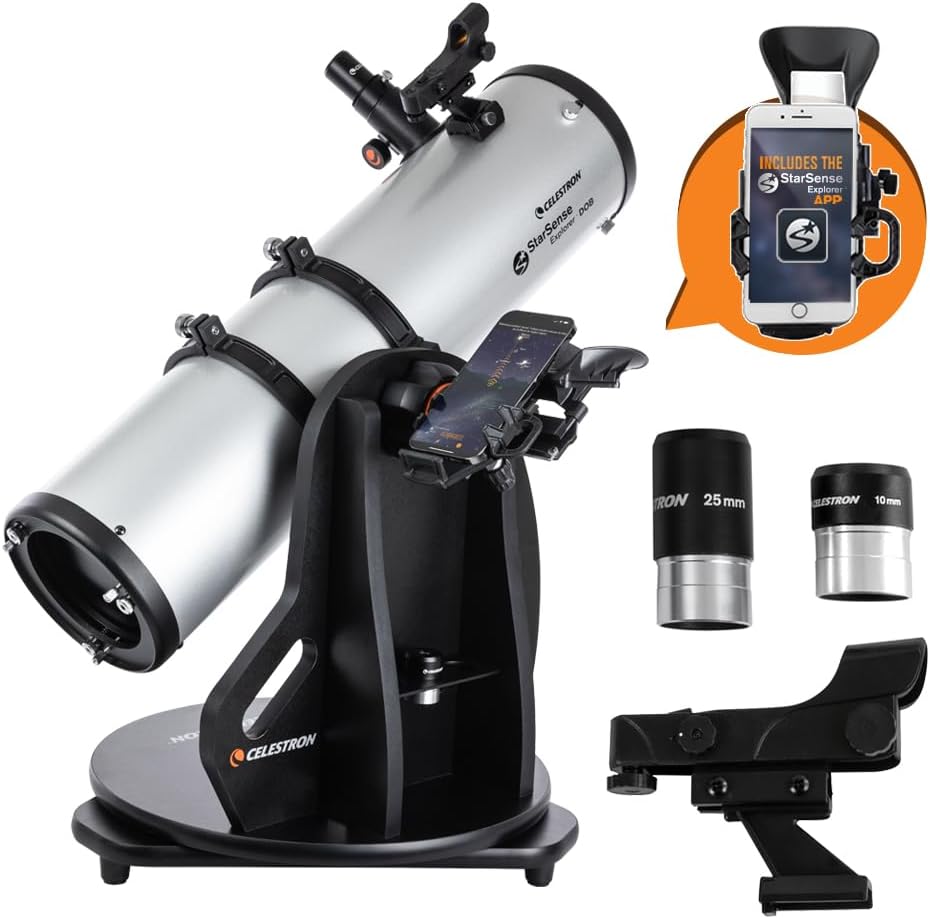
The Celestron StarSense Explorer 150mm brings a unique smartphone-powered approach to stargazing by using your phone's sensors to map the sky and guide you to targets. Instead of a complex motorized mount, it relies on a manual Dobsonian base that is simple to set up and easy to move once aligned by the app.
We may earn a commission when you buy through this link, at no additional cost to you.
The 150mm reflector provides impressive light gathering power, allowing you to see faint deep-sky objects and detailed views of the Moon and planets. The app interface is intuitive, showing you on-screen arrows to move the telescope until it is pointing at the correct spot, making navigation feel like an augmented reality game.
Because it is not fully motorized, you will need to track objects manually by nudging the telescope as they move across the sky. This keeps the weight and cost down but requires a bit more physical engagement during observing sessions which some users may find preferable to automated systems.
This telescope is ideal for adults who want a balance of advanced technology and hands-on simplicity. It removes the complexity of computerized mounts while still offering precise navigation, making it a great choice for families or casual observers who want great views without heavy equipment.
The StarSense app uses your phone to analyze the sky and provide directional arrows, removing the need to read star charts or remember object names.
The tabletop design means you do not need to assemble a heavy tripod or deal with heavy base legs, making it easy to set up on any sturdy table.
We may earn a commission when you buy through this link, at no additional cost to you.
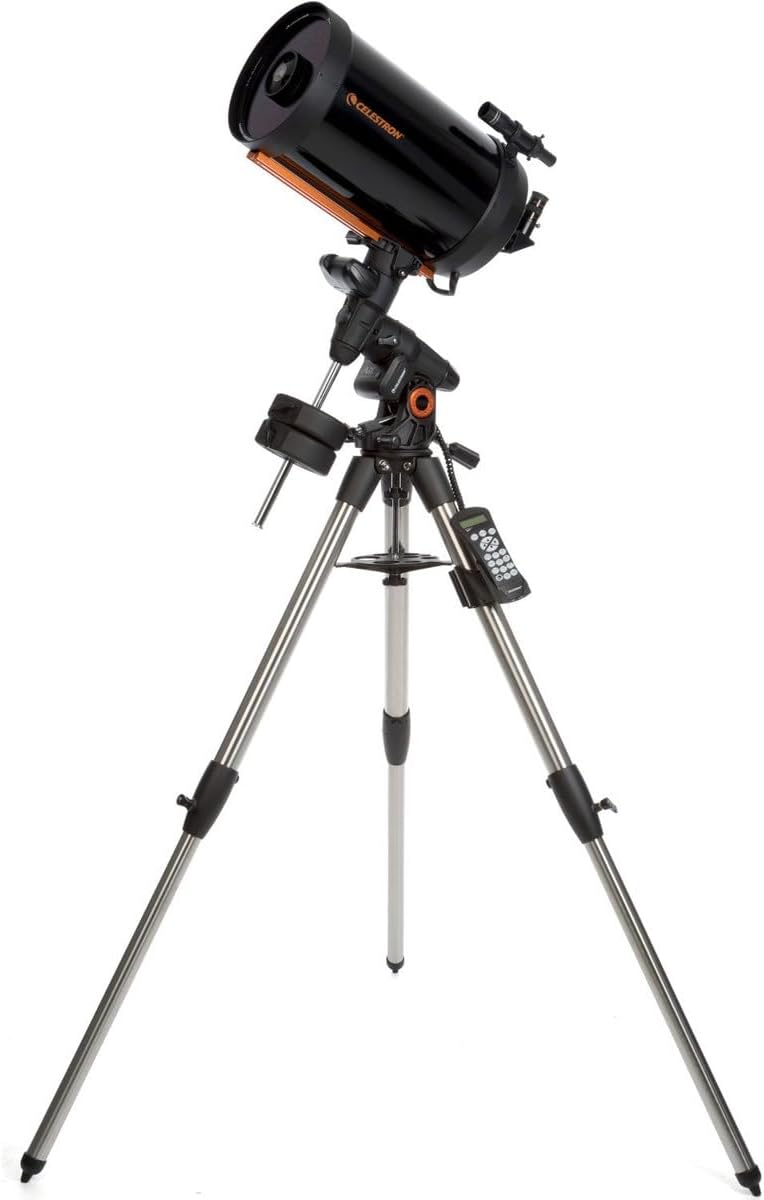
The Celestron Advanced VX 8 combines a robust German Equatorial mount with an 8-inch Schmidt-Cassegrain optical tube to create a system designed for stability and precision. The EQ mount is specifically engineered to track the Earth's rotation by moving along a polar axis, which is essential for long-exposure astrophotography.
We may earn a commission when you buy through this link, at no additional cost to you.
The stainless steel tripod included with this set is sturdy and adjustable, providing a stable platform that minimizes vibrations during viewing. This stability ensures that you can achieve high magnifications on planets without the image shaking, making it a reliable tool for serious visual observation and imaging.
Setting up an EQ mount requires polar alignment to ensure accurate tracking, which adds a step to the setup process compared to altazimuth systems. However, the advanced tracking capabilities and the ability to handle heavier accessories make this a worthwhile investment for those looking to move beyond basic visual observing.
This telescope is best suited for adults who are committed to learning more about astronomy and want a system that can support imaging work. The combination of optical power and mount stability makes it a versatile and professional-grade tool for the backyard observer.
The precise tracking of the EQ mount allows for longer exposures, enabling you to capture detailed images of nebulae and galaxies without trailing.
The heavy-duty tripod provides a solid foundation, ensuring that the telescope remains steady even when using high magnification eyepieces or cameras.
We may earn a commission when you buy through this link, at no additional cost to you.
The Celestron Advanced VX 9.25 offers a significant upgrade in light gathering power with its nearly 9.25-inch aperture, allowing you to see the faintest objects in the night sky. The Advanced VX mount ensures that this large optical tube tracks smoothly and accurately, providing stable views even at high magnifications.
We may earn a commission when you buy through this link, at no additional cost to you.
This setup is designed for adults who want to maximize their viewing experience and potentially pursue serious astrophotography. The high useful magnification means you can resolve fine details on planets and distant galaxies that smaller scopes simply cannot reveal, bringing you closer to the cosmos than ever before.
Due to its size and weight, this telescope requires a dedicated and stable setup area. It is not a quick-setup instrument but rather a robust tool for observers who have space for it and are willing to invest time in proper alignment to ensure optimal performance.
If you are an advanced observer looking for a high-performance telescope that delivers exceptional clarity and brightness, this model is a top choice. It represents a significant step up in capability for those who demand the best views possible from their backyard setup.
The large 9.25-inch aperture captures an immense amount of light, making faint deep-sky objects appear brighter and more detailed in the eyepiece.
The mount ensures smooth motion and precise alignment, which is critical for maintaining the stability needed for high magnification observations and imaging.
We may earn a commission when you buy through this link, at no additional cost to you.
The Celestron Advanced VX 6 brings the benefits of a German Equatorial mount to a lighter and more compact package. It features a 6-inch optical tube with high-quality coatings that provide sharp and bright images, making it an excellent choice for adults who want EQ stability without the bulk of larger models.
We may earn a commission when you buy through this link, at no additional cost to you.
This telescope is versatile enough for both visual observing and basic imaging. The mount provides the necessary precision for tracking objects across the sky, and the compact optical tube is easier to set up and transport, making it suitable for travel to darker sky sites.
While the aperture is smaller than the 8 or 9.25-inch versions, it still offers impressive views of the Moon, planets, and bright nebulae. The shorter focal length can make finding objects easier and provides a wider field of view which is great for observing larger deep-sky targets.
This model is ideal for adults who want a step up from altazimuth scopes but have space or transport constraints. It offers a balanced performance profile that allows you to explore the sky with precision while remaining manageable for regular use.
The compact size makes it easy to transport while still maintaining the precise tracking capabilities of an equatorial mount for steady viewing.
The high-quality optical coatings ensure that light transmission is efficient, resulting in sharp and bright views of celestial objects even in light polluted areas.
We may earn a commission when you buy through this link, at no additional cost to you.
Choosing the right computerized telescope involves understanding how optical design, mount type, and automation features work together to create a satisfying observing experience.
The optical design determines the quality and type of views you will get. Reflectors like Newtonians are cost-effective and great for deep-sky objects, while Schmidt-Cassegrains and Maksutovs are more compact and better for high magnification planetary viewing. Aperture size directly correlates to light gathering power, so a larger aperture will reveal fainter objects and more detail.
Look for an aperture that fits your budget and portability needs, ensuring it is large enough to see the details you care about such as planetary features or nebulae.
The mount is the foundation of your telescope. Computerized altazimuth mounts are simpler and easier to set up for visual observing, while equatorial mounts are better for tracking objects as the Earth rotates. Stability is critical because vibrations can blur the image even if the optics are excellent.
Ensure the mount is sturdy enough to hold the optical tube without shaking, especially if you plan to use high magnification or attach a camera for imaging.
Computerized systems automate the search for celestial objects using a database and motorized drive. Alignment is the process of teaching the mount where it is in the sky. Systems with SkyAlign or similar features simplify this by using any three bright stars rather than requiring you to find specific reference stars.
Choose a telescope with an intuitive control system and a robust database to make finding objects easy and to minimize setup time before observing.
Even with a computerized mount, you still need to transport the telescope to a dark location. Optical tube assemblies can vary significantly in weight. Consider whether you will be setting up in your backyard or if you need to carry the scope to a remote site which may require a lighter design or a vehicle.
Prioritize models that fit your vehicle and your physical ability to handle them to ensure you will actually use the telescope regularly.
If you plan to take photos of the sky you will need a mount that can track accurately over longer periods. Equatorial mounts are preferred for deep-sky imaging, while some altazimuth mounts can handle basic planetary photography. Ensure the telescope includes or can support a camera and necessary adapters.
Check if the system is rated for astrophotography or if it is better suited for visual use to avoid buying incompatible equipment for your goals.
Computerized telescopes vary in how complex they are to set up. Some offer app integration or automatic alignment which greatly reduces the learning curve. Others require manual polar alignment and more steps before you can start observing. Consider your patience level and technical comfort when choosing a model.
Look for features like Sky Tour or smartphone apps if you want to start observing quickly without spending hours on manual setup.
Telescopes range from affordable entry-level models to professional grade instruments. Consider what is included in the price such as eyepieces, tripods, and software. Sometimes buying a higher-quality scope with fewer accessories is better than buying a bundle with cheap extras.
Determine how much you are willing to spend and ensure the telescope offers features that match your current needs and have room for future growth.
Start by setting up the telescope on a level surface and extending the tripod legs fully to ensure stability. If your mount requires polar alignment for equatorial tracking, take time to align the mount with Polaris to enable accurate motion tracking.
Turn on the mount and use the hand control or app to initiate the alignment sequence. Select bright stars or use the automatic alignment features like SkyAlign to calibrate the system so the computer knows the position of the sky.
To observe an object, select it from the database and let the telescope slew to the target. Once centered, use the fine adjustment knobs to refine the view. For best results, allow the optics to cool to ambient temperature before high power viewing.
Most computerized telescopes require alignment each night to establish the mount position relative to the sky. However, some models have memory features that remember your location so you only need to align the mount once for a while. Using automatic alignment tools can speed this process up significantly for casual use.
Yes you can use a computerized telescope in the city although light pollution will limit how many deep-sky objects you can see. The computerized system helps find bright objects like planets and the Moon which are less affected by light pollution. Some modern digital telescopes are specifically designed to filter out light pollution for better views.
Prices for computerized telescopes vary widely based on size and features. Entry level models typically start in the lower hundreds while larger aperture or imaging-ready models can cost thousands. There is a wide range of options available to fit different budgets and performance needs.
Modern computerized telescopes are designed to be user-friendly with automated features that make alignment and finding objects much easier than manual scopes. Beginners should start with models that have helpful guides or app support to simplify the learning process and reduce frustration.
Many computerized telescopes can take pictures especially those with stable mounts designed for tracking. Basic models work well for planetary imaging while more advanced equatorial mounts are needed for deep-sky photography. You will need to attach a camera or dedicated astro-camera to the telescope for this purpose.
Regular maintenance involves keeping the optics clean and dry and occasionally checking the mount for smooth movement. You should avoid cleaning the lens or mirror unless necessary and store the telescope in a dry place to prevent damage from moisture. Batteries should be checked and replaced regularly to ensure the computerized system works correctly.
We have explored ten top-rated computerized telescopes that cater to a range of budgets and experience levels. From the portable and affordable NexStar 130SLT to the high-performance Odyssey PRO smart telescope, there is a model available for every type of observer looking to automate their stargazing.
When making your decision prioritize aperture size and mount stability as these factors have the biggest impact on what you will see through the eyepiece. If you are interested in imaging, ensure the system supports tracking long enough for your intended use.
Remember that prices and availability for these telescopes change frequently so always verify the current details before buying. We hope this guide helps you find the perfect telescope to inspire your journey into the wonders of the universe.