
msi Gaming GeForce GT 1030
4.5Editor score
Low profile design
4GB DDR4 memory
Single fan cooling
HDMI and DP outputs
This guide compares the top GPUs for Optiplex systems, covering low profile cards and performance options for gaming and professional workflows.
Choosing the right graphics card for your Optiplex system can transform its capabilities significantly. Whether you need more power for gaming or professional tasks, finding a compatible low profile GPU is essential for these compact desktops.
We have analyzed various models based on their size, performance metrics, and compatibility with Dell Optiplex chassis. Our list includes options ranging from entry level solutions to powerful cards capable of handling demanding workloads efficiently.
Each pick highlights specific strengths and potential limitations to help you make an informed decision. Please note that product availability and pricing can change frequently, so verify details before purchasing to ensure the best fit for your setup.
4.5Editor score

4.3Editor score

4.7Editor score
The following table provides a side-by-side comparison of all ten selected graphics cards. Use this overview to quickly assess key specifications and features before diving into detailed reviews.


The maxsun GeForce RTX 3050 is a strong contender for Optiplex upgrades, offering modern performance in a compact low profile form factor. It comes highly rated for its ability to handle casual gaming and everyday productivity tasks efficiently without requiring major case modifications.
We may earn a commission when you buy through this link, at no additional cost to you.
Powered by the NV Ampere architecture, this card leverages AI-specialized Tensor Cores and DLSS technology to boost game performance while maintaining image quality. Its 6GB GDDR6 memory and PCI Express 4.0 interface ensure smooth data transfer and compatibility with newer systems.
While it lacks an external power connector which limits peak performance potential, the card is designed for efficiency. This trade-off is acceptable for users prioritizing simplicity and compatibility with low wattage power supplies found in many Optiplex models.
Buyers looking for a reliable upgrade to transform their Optiplex into a capable media or light gaming machine should consider this model. It balances performance and physical constraints effectively, making it our top pick for most users.
Its slim low profile design fits perfectly into Mini Small Form Factor SFF computer pc cases, ensuring easy installation without bulky components.
AI-specialized Tensor Cores on GeForce RTX GPUs give your games a speed boost with uncompromised image quality through DLSS technology.
We may earn a commission when you buy through this link, at no additional cost to you.
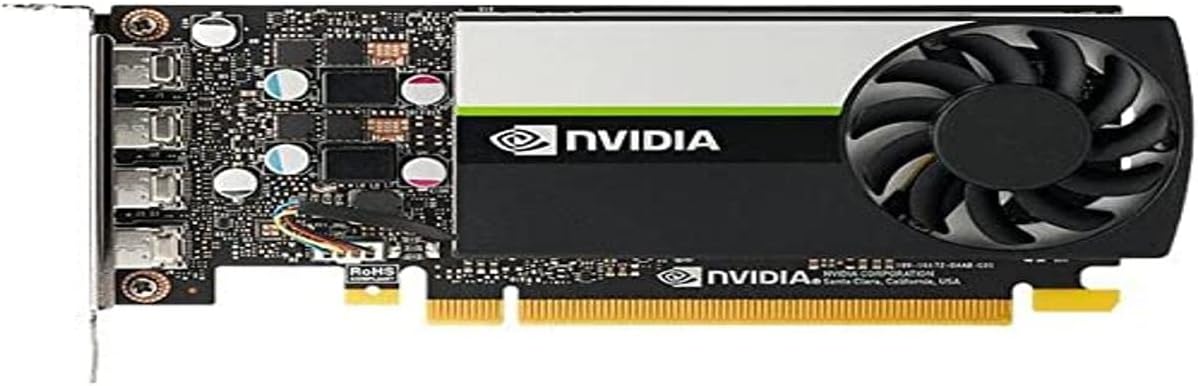
The PNY NVIDIA T600 is designed for professional workflows, delivering more than double the performance of the previous generation for 3D graphics workloads. It stands out for its stability and compatibility with a wide range of professional software applications used in design and visualization.
We may earn a commission when you buy through this link, at no additional cost to you.
This card allows users to work with larger models and scenes while maintaining higher levels of interactivity. Its support for multiple high-resolution displays enables immersive environments and complex visualization tasks without compromising system responsiveness or stability.
While it excels in professional settings, the focus on certification and stability means it may not be the first choice for pure gaming enthusiasts. However, for those requiring reliability and certified driver support, the trade-off is well justified.
Professionals needing a reliable upgrade for their Optiplex workstation should find this card meets their needs effectively. It ensures hardware compatibility and stability through NVIDIA support of the latest graphics standards and extensive ISV developer engagements.
Allows you to work with larger models, scenes, and assemblies, with higher levels of interactivity during design and visualization.
Can drive display resolutions for up to four 5K displays or two 8K displays per card for immersive environments.
We may earn a commission when you buy through this link, at no additional cost to you.
The PNY Nvidia RTX A400 is a single-slot, low-profile graphics card optimized specifically for compact business systems and professional environments. It delivers exceptional compute power for AI, ray-tracing, and modelling tasks while maintaining a small physical footprint.
We may earn a commission when you buy through this link, at no additional cost to you.
Equipped with 4GB GDDR6 memory and 768 CUDA cores, this card supports high-speed data transfer and seamless multitasking across demanding applications. Its support for PCI Express 4.0 provides enhanced bandwidth for next-gen connectivity in modern workstations.
While it may not be the primary choice for high-end gaming, its energy-efficient operation and reliability make it ideal for extended professional use. The low 50W power consumption ensures it runs cool and stable within tight chassis constraints.
Professionals looking to upgrade their Optiplex for video editing or 3D rendering will find this card offers the necessary power without bulk. It is our best premium pick for those prioritizing professional workflow efficiency and compact design.
Designed for professional workflows, it delivers exceptional compute power for AI, ray-tracing, and modelling tasks.
Energy-efficient operation with low 50W power consumption ensures reliability and performance for extended professional use.
We may earn a commission when you buy through this link, at no additional cost to you.
The ASUS Dual GeForce RTX 3050 brings next-generation gaming features to compact builds with its 2-slot design that maximizes compatibility and cooling efficiency. It is built with the powerful graphics performance of the NV Ampere architecture for demanding games.
We may earn a commission when you buy through this link, at no additional cost to you.
Featuring 2nd Generation RT Cores and 3rd Generation Tensor Cores, this card offers massive boosts in game performance and all-new AI capabilities. The Axial-tech fan design facilitates longer blades and increases downward air pressure for better thermal management.
While it is a robust card, its two-slot design requires a slightly larger case space compared to slim single-slot alternatives. However, the superior performance and IP5X dust resistance offer excellent value for users needing more power.
Gamers and creators with Optiplex systems that support slightly larger GPUs will appreciate this card's performance and durability. It delivers the throughput needed for ray-tracing and AI algorithms without compromising on build quality.
Axial-tech fan design features a smaller fan hub that facilitates longer blades and a barrier ring that increases downward air pressure.
Experience 2X the throughput of 1st gen RT Cores, plus concurrent RT and shading for a whole new level of ray-tracing.
We may earn a commission when you buy through this link, at no additional cost to you.
The msi Gaming GeForce GT 1030 is a budget-friendly graphics card that fits well in compact Optiplex systems. It offers a single fan OC design that ensures adequate cooling without requiring external power connectors or extra case space.
We may earn a commission when you buy through this link, at no additional cost to you.
With 4GB DDR4 video memory and support for DirectX 12, this card handles everyday media tasks and lighter gaming workloads efficiently. It includes HDMI 2.0b and DisplayPort 1.4a outputs for connecting modern monitors easily.
While it lacks the raw performance of newer Ampere-based cards, its low cost and compact size make it a solid entry-level choice. Users needing a simple upgrade for basic multimedia consumption will find it meets their needs adequately.
For those on a tight budget or needing just enough power for secondary displays, this model is an excellent starting point. It provides a straightforward way to add video output capabilities to legacy or budget Optiplex desktops.
Single fan OC graphics card with 64-bit memory interface fits easily into small form factor cases without extra power needs.
Supports DisplayPort x 1 (v1.4a) and HDMI 2.0b x 1 for connecting to current generation monitors and TVs.
We may earn a commission when you buy through this link, at no additional cost to you.
The GIGABYTE GeForce RTX 3050 features dual 2X WINDFORCE Fans to ensure excellent cooling performance in compact environments. It is powered by the GeForce RTX 3050 GPU with integrated 6GB GDDR6 memory for smooth data transfer.
We may earn a commission when you buy through this link, at no additional cost to you.
This card supports modern gaming features like 2nd Generation RT Cores and 3rd Generation Tensor Cores for AI acceleration. Its Ampere architecture brings 2X the FP32 throughput and improved power efficiency compared to previous generations.
While it may be slightly larger than single-slot alternatives, the dual fan design ensures better thermal headroom for sustained workloads. This makes it a strong candidate for Optiplex cases that can accommodate a dual-slot card.
Users looking for a balance of cooling and performance in a small footprint will find this model compelling. It brings the power of RTX technology to smaller systems without overheating concerns common in tight chassis.
Powered by GeForce RTX 3050 with 2X WINDFORCE Fans for effective thermal management in compact spaces.
Integrated with 6GB GDDR6 96-bit memory interface to support high-resolution gaming and creative work.
We may earn a commission when you buy through this link, at no additional cost to you.
The msi Gaming RTX 3050 LP is specifically designed for low profile cases while delivering powerful performance. It features a 96-Bit memory interface and 6GB GDDR6 memory to handle modern games and applications smoothly.
We may earn a commission when you buy through this link, at no additional cost to you.
With a boost clock of 1492 MHz, this card offers competitive speeds for its class. It includes HDMI 2.1a and DisplayPort outputs to support high refresh rates and resolution for connected displays.
While the cooling solution is compact to fit slim cases, it is sufficient for the power output of this card. This makes it ideal for users who need more than basic graphics without sacrificing physical form factor.
Optiplex owners looking for a straightforward upgrade that fits perfectly into standard low profile slots should consider this option. It provides a significant performance jump over integrated graphics while maintaining system integrity.
Video Memory is 6GB GDDR6 with 14 Gbps speed to ensure smooth data handling for demanding tasks.
Output includes DisplayPort x 1 (v1.4a) and HDMI 2.1a x 2 for multiple display connections.
We may earn a commission when you buy through this link, at no additional cost to you.
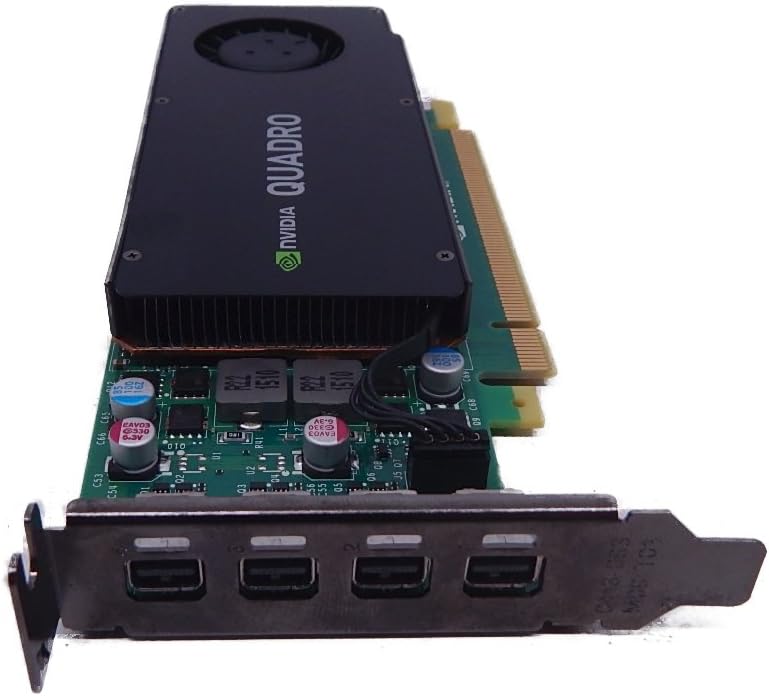
The PNY NVidia Quadro K1200 offers incredible 3D application performance in a compact footprint for older Optiplex systems. It includes Four Mini DisplayPort 1.2 Connectors to allow multiple displays for professional tasks.
We may earn a commission when you buy through this link, at no additional cost to you.
Designed for stability, this card comes with a 3-Year Warranty to ensure long-term reliability. It fits low profile chassis easily and does not require external power, making installation straightforward for legacy machines.
While it supports the older PCI Express 2.0 standard, it remains relevant for systems where bandwidth is not the bottleneck. The multiple display outputs make it valuable for trading desks or multi-monitor workstation setups.
For users maintaining older Optiplex hardware needing reliable multi-display support, this is a practical choice. It provides professional features in a small package that works well with legacy hardware constraints.
The NVIDIA Quadra K1200 offers incredible 3D application performance in a compact footprint with four Mini DisplayPort 1.2 Connectors.
Comes with a 3-Year Warranty ensuring long-term reliability for professional environments.
We may earn a commission when you buy through this link, at no additional cost to you.
The NVIDIA Quadro P1000 is a low-profile professional graphics solution that delivers up to 60% better performance than the previous generation. It provides professional users with the most memory and best performance available in a small form factor.
We may earn a commission when you buy through this link, at no additional cost to you.
Powered by NVIDIA Quadro Pascal GPU technology, this card supports 4K and 5K display support with extensive ISV certification. Its power efficient architecture ensures reliable operation without excessive heat generation in compact desktops.
While limited to 4GB of GDDR5 memory, this is often sufficient for standard professional workflows. The expansive visual workspace allows for up to four 4K displays, enabling users to view designs and projects in stunning detail.
Business users upgrading older Optiplex systems for CAD or design work will find this card reliable. It balances professional features with physical constraints to offer a stable upgrade path for legacy hardware.
Advanced and power efficient NVIDIA Quadro Pascal architecture GPU ensures the most powerful low profile graphics solution available.
An expansive visual workspace of up to four 4K displays lets professionals view their designs in stunning detail.
We may earn a commission when you buy through this link, at no additional cost to you.
The NVIDIA Graphics Card VCQK1200DVI-PB is built on the Quadro K1200 engine, offering professional features for legacy systems. It features 4GB GDDR5 memory and a PCI Express 2.0 x16 interface for reliable connectivity.
We may earn a commission when you buy through this link, at no additional cost to you.
Designed for stability, this card includes a DVI output which may be necessary for older monitors without HDMI ports. It fits into standard low profile slots and maintains low power consumption suitable for Optiplex power supplies.
While it lacks the latest connectivity standards, it remains a practical choice for users needing basic professional graphics. It provides essential multi-monitor support without requiring major system changes or upgrades.
For users with older Optiplex hardware relying on legacy display types, this card offers a simple solution. It ensures your system can support professional workloads within the physical constraints of small desktop cases.
Features DVI output included which is useful for connecting to older monitors without HDMI or DP inputs.
Graphics Engine is NVIDIA Quadro K1200 with 4GB GDDR5 memory for professional stability and reliability.
We may earn a commission when you buy through this link, at no additional cost to you.
Choosing the right GPU requires understanding your specific needs and system limitations. This guide breaks down the essential factors to consider before buying.
Optiplex systems often use Small Form Factor (SFF) cases with strict size limitations. Ensure the graphics card is low profile and single slot if your case is very compact. Measure your internal space before purchasing.
Always check the card height and length to guarantee it fits without obstruction. This prevents physical compatibility issues during installation.
Many Optiplex systems use power supplies that do not have external PCIe power connectors. Look for cards that draw power directly from the PCIe slot to avoid the need for adapters. This ensures safe and stable operation.
Prioritize low wattage models if your system relies on integrated power. Exceeding the wattage limit can cause system instability or shutdown.
Determine if you need the card for gaming, video editing, or basic productivity. Professional cards like the RTX A400 offer better ISV certification, while gaming cards like the RTX 3050 offer more raw FPS. Match the GPU to your workload.
Select a card with sufficient VRAM for your target resolution. 6GB is generally better for modern gaming than 4GB.
Check if your Optiplex supports PCI Express 4.0 or 3.0. Newer cards like the RTX 3050 support 4.0, which ensures maximum bandwidth. Older models might only support 3.0 which can bottleneck newer cards.
Verify the PCIe slot version on your motherboard. Most modern cards work in older slots but might run at reduced speeds.
Count the number of monitors you need to connect. Some cards like the Quadro K1200 offer multiple Mini DisplayPorts for multi-monitor setups. Ensure the card has the correct ports for your current displays.
Consider adapter availability if you need HDMI on a DP-only card. Having the right ports simplifies your setup process.
Prices vary significantly between entry-level and high-end cards. The GT 1030 is much cheaper than the RTX 3050 but offers less performance. Decide how much value you need for your specific tasks.
Balance your budget against long-term use. A slightly more expensive card might offer better longevity and performance headroom.
Professional cards often come with certified drivers that ensure stability for work apps. Gaming cards are optimized for frequent releases to support new game titles. Consider what type of stability you need.
Check the age of the card. Older models might reach end of support sooner than newer architectures.
Compact cases often have limited airflow. Look for cards with passive cooling or low-power designs to minimize heat buildup. This protects the longevity of your system components.
Ensure your case allows for adequate ventilation around the GPU. Overheating can lead to throttling and reduced performance.
Before installing your new GPU, power off your system and unplug the power cable to ensure safety. Open the case and remove any existing graphics card to prepare the PCIe slot for the new one.
Align the new card with the PCIe slot and press down firmly until it clicks into place. Secure the bracket to the chassis using a screw to prevent movement. Ensure all connections are tight and secure.
Power on your system and install the latest drivers from NVIDIA's official website. Regularly update drivers to maintain performance and security. Clean dust from the card and fans periodically to ensure proper cooling.
Generally no because standard Optiplex SFF cases are designed for low profile and single slot cards. Full size cards will physically block internal components or not fit inside the chassis. You should look specifically for low profile GPUs.
Most recommended cards draw power directly from the motherboard so no special power supply is needed. Ensure your current PSU has enough wattage but most small form factor cards use low power.
The RTX 3050 models like the maxsun or MSI options offer the best balance of gaming performance and size. They support modern gaming features while fitting in compact cases without extra power needs.
Yes but check your motherboard compatibility for CPU upgrades first. The GPU upgrade is usually independent but ensure the power supply can handle both upgrades if you plan significant changes.
Professional GPUs have ISV certifications that ensure stability for specific software. For standard tasks gaming cards work fine but for critical business apps the professional cards offer better support.
Check your motherboard manual or system specifications online. Newer Optiplex models like the 3060 or 7080 usually support 4.0 but older models might be limited to 3.0.
The RTX 3050 options provide excellent balance for most users seeking performance in a compact form factor. The GT 1030 remains a great budget choice for basic tasks without breaking the bank.
Prioritize physical size and power needs before focusing on raw performance. A card that fits and runs cool is better than a powerful one that cannot be installed safely.
Always verify current availability and specific system requirements before buying. Prices and stock fluctuate so check the latest details to ensure compatibility with your specific Optiplex model.