
LAFVIN Basic Starter Kit for ESP32
4.5Editor score
ESP32 WiFi IoT Board
Includes Detailed Tutorials
Beginner Friendly Design
Explore our expert guide comparing the top microcontroller kits for beginners in 2026 to help you choose the right hardware for learning electronics and coding.
Choosing the right microcontroller kit for beginners can transform a curious hobbyist into a skilled maker. These kits provide essential components, tutorials, and boards to help you learn electronics and coding without frustration.
We compared ten leading kits based on component quality, tutorial depth, ease of use, and project variety. Our analysis focuses on value, educational content, and hardware reliability for new learners starting their journey.
Each pick highlights unique strengths, from budget-friendly options to advanced IoT setups. Prices and availability change frequently, so verify current details before purchasing to ensure you get the best deal for your needs.
4.5Editor score

4.7Editor score

4.6Editor score
This side-by-side comparison highlights the core specifications and unique features of each kit to help you decide which platform aligns best with your learning goals and project interests.


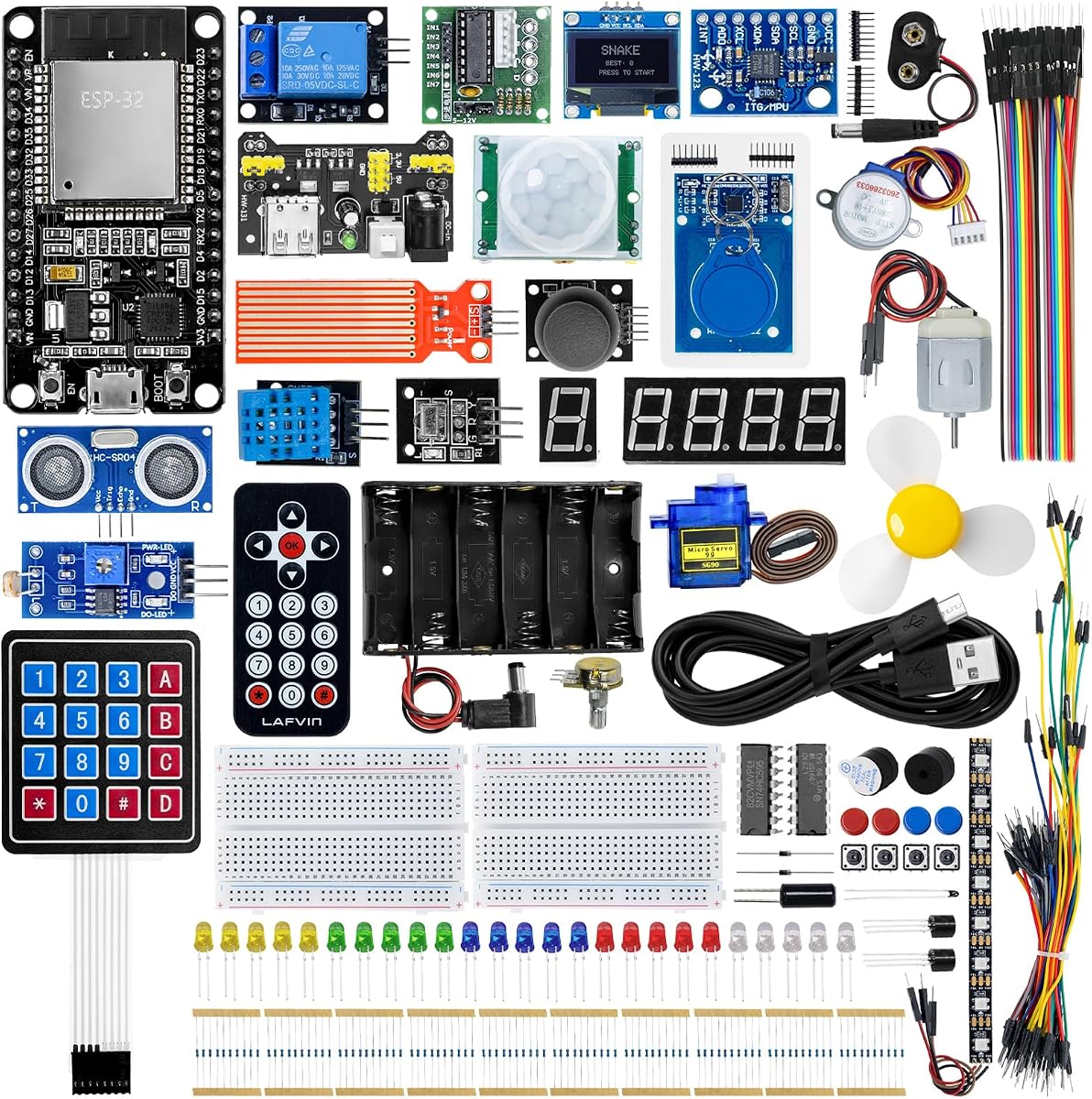


The LAFVIN Basic Starter Kit for ESP32 offers an accessible entry into modern IoT development. With a 4.5 rating, it balances cost and functionality well for first-time users interested in wireless projects.
We may earn a commission when you buy through this link, at no additional cost to you.
This kit focuses on the ESP32 platform, known for its dual-core processing and built-in connectivity. Users can control LEDs, read sensor data, and connect to home networks using familiar Arduino IDE tools.
While the packaging is simple, the included tutorial provides necessary wiring guides and sample code. Beginners may need to source a separate power adapter but gain valuable exposure to ESP32 modules early.
Ideal for hobbyists wanting WiFi features without high costs, this kit delivers core value. It is best for those comfortable sourcing minor extras and following detailed text instructions independently.
The ESP32 module enables real-time web control and data monitoring without extra hardware.
Step-by-step lessons help users understand assembly and basic coding logic efficiently.
We may earn a commission when you buy through this link, at no additional cost to you.
The REXQualis Super Starter Kit earns our top recommendation for its completeness. A 4.7 rating reflects user satisfaction with the included power adapter and well-organized plastic storage container.
We may earn a commission when you buy through this link, at no additional cost to you.
Built around the reliable Arduino UNO R3, it supports a vast library of shields and tutorials. Components arrive labeled and prepped with pin headers to reduce assembly time for new learners.
Costs more than minimal kits but saves money by avoiding extra purchases like batteries. The PDF datasheets and guides ensure users can troubleshoot common circuit issues independently.
This is the best all-around package for students or classrooms needing a turnkey solution. It balances hardware reliability with educational depth to support steady progress in electronics.
The included adapter ensures stable power without needing separate batteries for testing.
Labeled compartments keep small components safe and easy to find during projects.
We may earn a commission when you buy through this link, at no additional cost to you.
This premium kit stands out with the ESP32-S3 camera board, offering powerful image processing and AI capabilities. With 243 items, it supports complex smart home and robotics projects out of the box.
We may earn a commission when you buy through this link, at no additional cost to you.
Users receive three code sets including MicroPython and C, plus Processing for graphical interfaces. The 828-page tutorial covers everything from wiring to advanced camera integration in detail.
While ideal for serious makers, beginners should expect a learning curve. The sheer volume of parts offers rich opportunities but requires patience to organize and understand fully.
Best suited for learners planning deep dives into IoT vision and machine learning. It provides future-proof hardware that scales well as skills grow over months of projects.
The onboard camera enables projects involving image recognition and video streaming.
Over 121 projects guide users from basic wiring to complex algorithm implementation.
We may earn a commission when you buy through this link, at no additional cost to you.
The amomii Testudo kit uniquely combines soldering practice with project building for a hands-on experience. With a 4.7 rating, it excels at teaching hardware assembly and circuit analysis step by step.
We may earn a commission when you buy through this link, at no additional cost to you.
Three modular gadgets allow swapping between 10+ software functions via a web tool. This encourages experimentation without needing complex code setup for initial play and testing.
Safety warnings note that soldering irons are not included and minors need supervision. Beginners gain practical skills but should prepare tools and a safe workspace before opening the box.
Perfect for those wanting to master physical assembly before jumping into software coding. The escape room challenge adds a gamified layer that motivates careful component placement and testing.
Includes a course on joint anatomy and safety to build confidence in soldering.
Interchangeable shields allow reusing the main board for many unique gadgets.
We may earn a commission when you buy through this link, at no additional cost to you.
Horizon Uno provides a full online video course alongside the hardware to guide new users. With a 4.7 rating, this kit emphasizes visual learning through engineers explaining real-world projects clearly.
We may earn a commission when you buy through this link, at no additional cost to you.
Each lesson includes labs and problem sets to reinforce concepts like electricity and logic. Components are chosen for reliability to ensure circuits work as shown in the videos.
The unique access code grants lifetime course access which adds long-term value. However, learners relying solely on videos might have less flexibility to write custom code independently.
Recommended for visual learners and educators needing structured classroom material. The combination of premium parts and video instruction simplifies the start to electronics significantly.
Students retain access to lectures and labs indefinitely for reference.
Premium parts minimize failed circuits and keep focus on learning concepts.
We may earn a commission when you buy through this link, at no additional cost to you.
This kit centers on the Raspberry Pi Pico, offering the RP2040 chip with strong Python capabilities. A 4.5 rating reflects success with users seeking high-level coding over low-level assembly.
We may earn a commission when you buy through this link, at no additional cost to you.
Components like the RGB LED and LCD provide rich feedback for testing scripts. Sample code supports MicroPython and C/C++ to bridge beginners from scripts to compiled projects.
The RP2040 handles multitasking better than standard Arduino boards. However, library support is slightly narrower requiring careful checking of component compatibility.
Best for those already familiar with Python or school labs using graphical tools. It introduces microcontrollers through a flexible language that feels modern and accessible.
MicroPython allows faster script iteration and easier debugging for newcomers.
The dual-core processor supports advanced tasks like audio playback and data logging.
We may earn a commission when you buy through this link, at no additional cost to you.
LAFVIN ESP32 Ultimate Kit expands possibilities with diverse modules like RFID and MPU6050 sensors. A 4.3 rating suggests solid utility but requires patience with assembly and wiring steps.
We may earn a commission when you buy through this link, at no additional cost to you.
Projects focus on IoT integration like remote monitoring and smart home controls. Users learn to build interfaces on smartphones or computers using standard web browsers.
Component variety exceeds basic kits but may overwhelm absolute beginners. The detailed diagrams help but expect to spend time calibrating sensors and testing connections.
Ideal for makers wanting to build functional IoT prototypes without buying parts separately. It balances depth and cost well for those ready to tackle slightly complex builds.
Projects teach real-world web control and sensor data transmission over networks.
Includes environmental and motion sensors to build responsive automation systems.
We may earn a commission when you buy through this link, at no additional cost to you.
The GeeekPi kit provides a curated set of modules for Raspberry Pi Pico users. With a 4.4 rating, it appeals to developers comfortable with Python seeking to move into embedded systems.
We may earn a commission when you buy through this link, at no additional cost to you.
I2C LCD and breadboard setup allow testing code quickly without soldering. Free manuals are downloadable ensuring documentation remains available for future projects.
It lacks some of the extensive sensor variety of ultimate kits but offers focused quality. Software engineers appreciate the direct path from coding scripts to hardware execution.
Best for users already familiar with Raspberry Pi software who want embedded expansion. It bridges the gap between desktop programming and physical computing effectively.
Kit prioritizes Python workflows that match software engineering backgrounds.
Online wiki ensures up-to-date tutorials and troubleshooting help.
We may earn a commission when you buy through this link, at no additional cost to you.
With a perfect 5.0 rating, this kit stands out for reliability and component volume. The USB-C connection and dual-core processor provide modern performance for complex connected tasks.
We may earn a commission when you buy through this link, at no additional cost to you.
Over 35 modules offer extensive build options from weather stations to RC devices. Projects guide users from basic circuits to smart home controllers step by step.
A known QR error on the manual requires contacting support for resources. Despite this minor issue, community support and quality testing ensure a smooth experience.
Highly recommended for those seeking modern connectivity and robust support. The USB-C and dual-core features make it future-ready for advanced IoT needs.
USB-C allows faster data transfer and easier charging options.
Active teams assist with debugging and project customization.
We may earn a commission when you buy through this link, at no additional cost to you.
This kit features the classic ESP32 camera board offering strong imaging capabilities and Bluetooth support. A 4.6 rating reflects user satisfaction with the project variety and component quality.
We may earn a commission when you buy through this link, at no additional cost to you.
With 240 items, it includes most essentials for home automation and sensor networks. Tutorials guide through 122 projects ensuring learners progress from basics to smart systems.
The board has 4MB flash which is slightly lower than newer models but sufficient for most tasks. It remains an affordable gateway into visual projects and robotics.
Best for students needing an all-in-one kit with proven stability. It balances cost and features well for general learning and hobbyist imaging experiments.
Onboard camera enables security monitoring and image-based robotics projects.
Over 122 guides ensure a steady progression of new skills.
We may earn a commission when you buy through this link, at no additional cost to you.
Selecting the right kit depends on your preferred programming language, project types, and budget. Understanding these factors helps you avoid hardware limitations or missing tutorials.
Choose between Arduino, ESP32, or Raspberry Pi Pico based on your interests. Arduino offers the widest library support while ESP32 adds built-in WiFi and Bluetooth for IoT.
Pick a platform that matches your future goals to avoid relearning hardware.
Look for kits that include essential sensors like temperature, motion, and displays. High-quality resistors and labeled parts prevent frustration during testing.
A larger component count allows for more complex and varied projects.
Ensure the kit comes with step-by-step guides or video lessons. Comprehensive documentation covers wiring diagrams and code examples to speed up learning.
Good tutorials save time troubleshooting and help beginners understand underlying principles.
Decide if you prefer C++ or MicroPython. Some boards support both allowing you to start with simpler scripts before moving to compiled code.
Language flexibility helps learners grow into software development roles.
For smart home projects, ensure the board supports WiFi or Bluetooth. USB-C ports are modern standard offering faster data transfer and easier power supply.
Connectivity options expand what you can build beyond simple local circuits.
Check if the board supports shields or modular add-ons. A modular design lets you upgrade your setup without buying a whole new kit.
Scalable kits offer better long-term value as your skills improve.
Balance cost against included accessories. Sometimes a higher price covers power adapters and storage boxes that save extra trips to stores.
Prioritize kits that offer all essentials to keep total project costs down.
Always start with the provided tutorial to understand component placement and wiring. Follow diagrams closely to avoid short circuits that can damage the board.
Store components in the provided containers to prevent losing small pins or wires. Organizing parts by type makes future builds much faster.
Keep the board away from moisture and extreme heat. Use a breadboard for testing instead of soldering until you are confident in your circuit designs.
No prior experience is necessary as most kits include beginner tutorials. You can start with simple visual programming or basic scripts before advancing to complex code.
Most kits include a power adapter or support USB power. Check the board requirements to ensure you use the correct voltage to avoid damage.
Yes, you can add sensors or modules from standard electronics stores. Boards like Arduino and ESP32 have wide compatibility with third-party parts.
Basic kits often use breadboards so soldering is not needed initially. Advanced kits may require it but include guides to help beginners learn safely.
MicroPython is often easier for beginners due to simpler syntax. C++ provides deeper control but requires more understanding of memory and hardware details.
Simple projects like LED blinks take minutes while full sensors may take hours. Tutorials are designed to progress slowly so you learn as you build.
Our top picks offer excellent starting points for different learning styles and budgets. Whether you want WiFi IoT or video-based learning there is a suitable option available.
Prioritize kits with clear documentation and quality parts to minimize frustration. Choosing a platform with strong community support helps solve problems quickly.
Always check current prices and stock levels before purchasing. Updates and bundles change regularly ensuring you get the best value for your investment.