
Loto OSC482 Series
5 in 1 functionality
20MHz bandwidth
50MS/s sampling rate
Choosing the right PC oscilloscope can transform how you diagnose electrical signals in your projects. Whether you are a student, hobbyist, or professional engineer, having a reliable device is essential for accurate measurements. This guide highlights top models that connect seamlessly to your computer.
We evaluated ten distinct options based on bandwidth, sampling rate, channel count, and connectivity features. Our analysis focuses on real-world usability, software compatibility, and overall value for money. Each product was reviewed for its ability to handle various signal types effectively.
Every pick in this list offers unique strengths tailored to different needs and budgets. You will find detailed breakdowns of specifications and key features for each device. Please note that pricing and availability may change over time as market conditions shift.
4.8Editor score

4.7Editor score
As an Amazon Associate we earn from qualifying purchases.
This side-by-side comparison outlines the key specifications and capabilities of each selected PC oscilloscope. Use this table to quickly identify which model meets your specific testing requirements.


The Owon VDS1022I stands out as a highly accessible PC oscilloscope for entry-level users. It boasts a 25 MHz bandwidth and an impressive 1GS/s real-time sample rate. The device includes essential features like FFT and X-Y views on one screen.
We may earn a commission when you buy through this link, at no additional cost to you.
Its USB isolation feature is particularly valuable for protecting your computer from signal interference. This safety measure ensures your PC remains secure while measuring external electrical signals. The ultra-thin design makes it easy to carry for fieldwork or lab use.
While the bandwidth is lower than premium models, it is sufficient for many hobbyist tasks. The UI is friendly and supports multiple trigger options such as edge and pulse. Some users might find the lack of advanced decoding limiting for complex projects.
This scope is ideal for students or makers needing reliable signal visualization without high costs. It balances performance and portability effectively for general electronic troubleshooting. We recommend it for those prioritizing safety and ease of use.
The built-in USB isolation prevents ground loops and protects your computer hardware from voltage spikes during measurements.
Users can view waveform data and FFT analysis simultaneously on the same screen for efficient signal inspection.
We may earn a commission when you buy through this link, at no additional cost to you.
The Siglent Technologies SDS1202X-E offers professional-grade capabilities for serious engineers and technicians. It provides a 200 MHz bandwidth and a real-time sampling rate of 1 Gsa/s. The record length reaches up to 14Mpts for detailed waveform capture.
We may earn a commission when you buy through this link, at no additional cost to you.
Standard serial bus triggering and decoding support protocols like IIC, SPI, and UART. This feature simplifies the analysis of communication signals without needing external equipment. The grey design fits well into modern lab environments with a sturdy build.
Though it requires a computer for full functionality, the performance justifies the investment. Users benefit from high-resolution data and comprehensive decoding options out of the box. Some may find the cost steep for casual hobbyists but it pays off in accuracy.
This model is best suited for professionals requiring detailed signal analysis and reliability. It excels in environments where precision and protocol support are critical daily. We suggest it for those needing a robust digital oscilloscope.
Built-in decoding for common serial buses allows engineers to inspect communication traffic without extra tools.
The extended record length ensures long-duration captures without losing detail in fast signals.
We may earn a commission when you buy through this link, at no additional cost to you.
The Siglent SDS814X HD delivers exceptional clarity with its 12-bit analog to digital converter. This resolution allows for finer signal details compared to standard 8-bit scopes. It features 4 channels and a 100 MHz bandwidth with 2GSa/s sampling.
We may earn a commission when you buy through this link, at no additional cost to you.
A 7-inch touch screen provides an intuitive interface for navigating complex menus easily. Waveform capture rates reach up to 80,000 wfm/s in normal mode for reliable glitch detection. It also supports optional digital channels via specific probes sold separately.
This scope is excellent for applications demanding high precision and multi-channel observation. The high capture rate ensures you rarely miss transient events during testing. Users should note that full mixed-signal functionality requires additional accessory purchases.
Ideal for advanced users seeking resolution that rivals much more expensive models. It bridges the gap between entry-level and premium oscilloscopes effectively. We recommend it for those needing high-resolution analog signal analysis.
The 12-bit ADC captures subtle voltage changes that 8-bit scopes might overlook during complex testing.
The 7-inch touch screen allows for quick adjustments and intuitive control over measurement settings.
We may earn a commission when you buy through this link, at no additional cost to you.
The Loto OSC482 Series offers a versatile 5-in-1 design for various testing needs. It includes an oscilloscope, signal generator, logic analyzer, and data logger in one unit. With 20MHz bandwidth and 50MS/s sampling, it handles basic signals well.
We may earn a commission when you buy through this link, at no additional cost to you.
Users can add optional modules like the OSC482S or OSC482L to expand functionality further. This modularity allows you to build the exact toolset you require without multiple devices. The software interface is virtual and runs on your computer system.
This device is perfect for hobbyists needing multiple functions in a single portable package. While not suitable for high-frequency professional work, it covers many standard repair tasks. The flexibility of combining tools makes it a unique option in this list.
Recommend for home users or students wanting to learn different aspects of electronics testing. It saves space and money compared to buying separate instruments. We suggest it for those prioritizing versatility over raw speed.
Optional modules let you add signal generation or logic analysis capabilities as your projects grow.
Running via PC software provides a large display area and easy data export features.
We may earn a commission when you buy through this link, at no additional cost to you.
The Autel MaxiScope MP608 is specifically designed for modern automotive electrical diagnosis. It features 4 channels with 20MHz bandwidth and 12-bit resolution for precise measurements. The device is USB-powered and works seamlessly with compatible tablets.
We may earn a commission when you buy through this link, at no additional cost to you.
Advanced trigger modes help catch intermittent faults that are otherwise hard to reproduce. It supports bus decoding for CAN, CAN FD, and FlexRay protocols essential for EV and hybrid systems. Auto probe configuration reduces setup errors significantly during busy repairs.
This tool is ideal for professional mechanics needing quick and accurate vehicle signal analysis. The guided test library provides step-by-step instructions to simplify troubleshooting. It is less useful for general electronics work outside of automotive contexts.
Best suited for repair shops focusing on advanced electrical diagnostics in vehicles. The included accessories ensure you are ready to test immediately. We recommend it for technicians seeking efficiency and accuracy.
Automatic detection and calibration of probes save time and prevent measurement errors during busy shifts.
Preloaded test libraries offer wiring guides and reference waveforms to simplify complex repairs.
We may earn a commission when you buy through this link, at no additional cost to you.
This upgrade of the MP408 brings enhanced features for automotive professionals. It includes a full accessory kit and supports a wide range of MaxiSys tablets. Windows PC compatibility ensures flexibility for those without specific tablets.
We may earn a commission when you buy through this link, at no additional cost to you.
The 12-bit precision remains consistent with high accuracy for diagnosing subtle faults. Auto probe configuration continues to streamline setup for busy shop environments. It supports multi-protocol bus decoding for modern vehicle communication systems.
Mechanics will appreciate the guided test library that speeds up diagnosis processes. The upgrade ensures better compatibility with newer vehicle standards and software updates. It is a solid investment for those upgrading from older models like the MP408.
Best for mobile mechanics and professional shops needing a reliable diagnostic tool. The comprehensive kit means you have everything needed for immediate use. We recommend it for users already invested in the Autel ecosystem.
Compatibility with a broad range of MaxiSys tablets ensures flexibility for different shop setups.
A full accessory kit with probes and leads ensures you can start testing right out of the box.
We may earn a commission when you buy through this link, at no additional cost to you.
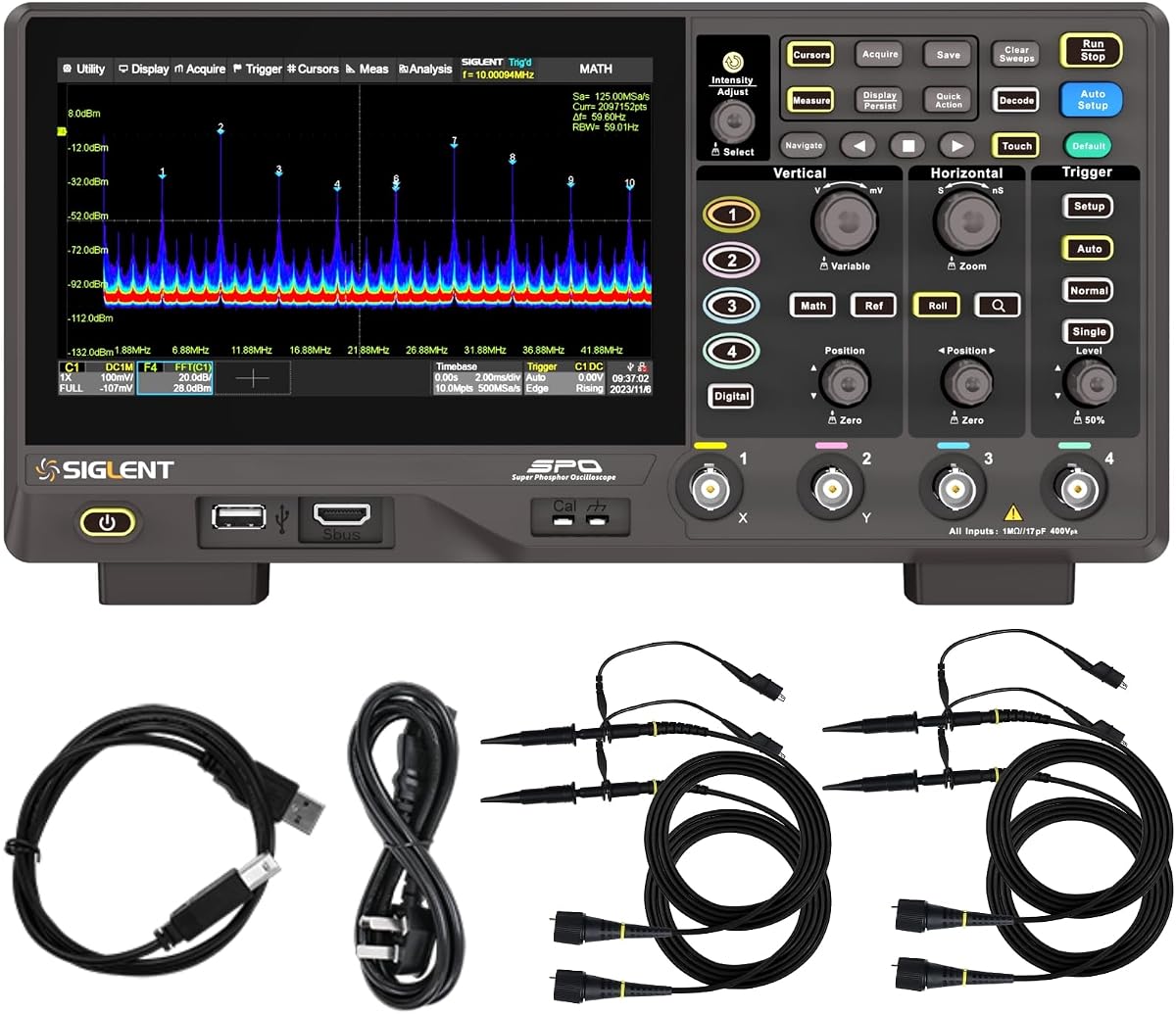
The Siglent Technologies SDS1104X-E provides a reliable four-channel option for lab work. It delivers 100MHz bandwidth and standard decoding for common protocols. The package supports optional digital channels for expanded mixed signal analysis.
We may earn a commission when you buy through this link, at no additional cost to you.
Users can add an USB AWG module to turn the scope into a signal generator too. This versatility makes it a central piece of equipment for electronics testing. The grey design is durable and professional for laboratory environments.
It balances performance and cost effectively for users needing more than two channels. The standard decoder covers most basic requirements for digital bus debugging. Some may prefer higher resolution but this model meets general testing needs.
Ideal for students or professionals needing multi-channel input without excessive cost. It offers a robust platform for general electronic design work. We recommend it for those needing a standard four-channel instrument.
Optional logic and AWG modules allow you to expand the scope's capabilities as your projects evolve.
Built-in support for UART and CAN ensures easy decoding without extra software or hardware.
We may earn a commission when you buy through this link, at no additional cost to you.
The DSO 138 DIY kit is a handheld tool designed for electronics education. It features a 2.4-inch color display and 1MSPS sampling rate for basic signals. You must assemble the kit yourself to understand its internal structure.
We may earn a commission when you buy through this link, at no additional cost to you.
This device is perfect for students wanting to learn about oscilloscope hardware and software. It allows tailor-made software development on the ARM Cortex-M3 processor. The low sampling rate limits it to low-frequency signals like audio.
Its small size makes it easy to carry for quick checks or demonstrations. The open-source nature allows you to modify functionality for specific learning needs. It is not a professional tool but serves its educational purpose well.
Best for teaching electronics principles to beginners or hobbyists. The assembly process provides valuable insight into digital signal processing. We recommend it for those wanting a fun and educational project.
The open-source design allows you to customize software for specific educational or hobby projects.
Building the unit provides deep insight into how digital oscilloscopes work internally.
We may earn a commission when you buy through this link, at no additional cost to you.
The OS-5C is a portable unit offering five channel synchronous monitoring. It features 1MHz bandwidth specialized for low-frequency signals like audio and sensors. The large 4.3-inch screen provides rich detail for effective viewing.
We may earn a commission when you buy through this link, at no additional cost to you.
Connectivity includes both USB and WiFi for flexible data transfer options. It weighs only 350g making it very easy to carry around your workspace. The device can record up to 90 hours of data in computer software.
This scope is excellent for industrial monitoring tasks where portability is key. While not built for high-speed digital logic, it handles sensor and power data well. The large battery ensures long operation time without needing constant charging.
Best for maintenance technicians needing a portable monitoring tool. The ability to record long data sets is useful for intermittent issues. We recommend it for users prioritizing mobility and channel count.
A built-in 2000mAh battery allows for continuous work over three hours without external power.
Wireless connectivity lets you view data on Android PCs without physical cables.
We may earn a commission when you buy through this link, at no additional cost to you.
The Korg Nu:Tekt NTS-2 allows you to build your own scope without soldering. It features a compact design perfect for musicians and creatives needing signal analysis. The kit includes a flexible waveform generator and spectrum analyzer.
We may earn a commission when you buy through this link, at no additional cost to you.
You can monitor control voltage and audio signals directly with its four channels. The interface is simple and intuitive for quick understanding of signal patterns. Dual stereo inputs and outputs ensure versatile connectivity in any studio.
This tool enhances learning and experimentation with visual signal representation easily. It is ideal for live performance use to add precision to audio setups. While limited to audio contexts, it excels at that specific purpose.
Best for musicians and sound designers wanting hands-on signal analysis. The no-soldering build makes it accessible for all experience levels. We recommend it for creative professionals seeking visual audio feedback.
The assembly process requires no soldering making it accessible for users without soldering skills.
Monitoring control voltage and audio signals visually helps refine sound design instantly.
We may earn a commission when you buy through this link, at no additional cost to you.
Selecting the right PC oscilloscope depends on your specific testing needs and budget constraints. This section outlines the primary factors to evaluate before making a purchase.
Bandwidth determines the maximum frequency the device can measure accurately. Always choose a scope with at least five times the highest frequency in your signals. Higher bandwidth ensures better fidelity for fast digital edges.
Prioritize models with sufficient bandwidth to avoid signal distortion during testing.
The sampling rate defines how many data points the scope captures per second. A higher rate allows you to see fast transients without aliasing. Look for rates that match your bandwidth needs effectively.
Ensure the sample rate supports your fastest signal requirements for accuracy.
Channels allow you to view multiple signals at once on one screen. Two channels work for basic tasks but four are better for complex circuits. Consider future needs when deciding on channel count.
Select enough channels to monitor all parts of your circuit simultaneously.
Memory depth determines how much waveform data can be stored for analysis. Larger memory allows longer capture times without losing resolution. This is vital for debugging intermittent glitches over time.
Check record length to ensure you can capture long sequences.
Modern scopes connect via USB WiFi or Ethernet to your computer. Ensure the connection is stable and supported by your operating system. Good software integration makes analysis much easier.
Verify connection types match your computer setup before buying.
Probes are essential for safely connecting to the device under test. Some scopes include probes while others sell them separately. Look for auto-calibration features to reduce setup errors.
Check if probes are included or sold separately with the scope.
Weight and size matter if you move the device between labs or jobs. A compact design is useful for fieldwork or classroom demonstrations. Ultra-thin body designs save space in your toolkit.
Choose a form factor that fits your work environment comfortably.
Digital scopes often support decoding of protocols like CAN or SPI. This feature saves time analyzing communication signals without extra tools. Ensure the scope supports the protocols relevant to your work.
Look for built-in protocol decoders if working with digital buses.
Always start by connecting the ground lead to a common ground point before attaching signal probes. This prevents electrical shocks and protects your equipment from damage. Proper grounding ensures accurate readings and user safety.
Calibrate your probes regularly to maintain measurement accuracy over time. Adjust compensation caps so the square wave appears flat without overshoot. Clean the screen and connectors with a soft dry cloth to avoid scratches.
Store the device in a dry dust-free environment when not in use. Avoid exposing the unit to extreme temperatures that might affect internal components. Regular updates to the software ensure you have the latest features available.
A PC oscilloscope is a device that connects to a computer to visualize electrical signals. It uses software on your computer to display waveforms instead of a built-in screen. This setup saves cost and provides powerful analysis tools.
Most devices come with dedicated software for Windows or Android systems. Some use virtual scopes that run on any browser. Always check compatibility before purchase to ensure it works with your computer.
Yes if you choose a model with sufficient bandwidth and sampling rate. Professional models offer higher specs for RF and fast digital work. Entry-level kits are better suited for low frequency audio signals.
It depends on the specific model you buy. Some budget units include basic probes while others sell them separately. Check the product description to confirm what is included in the package.
Some models are specifically designed for automotive electrical diagnostics. These units support CAN bus decoding and come with specialized probes. General hobby scopes may work but lack specific automotive tools.
DIY kits vary by design and complexity. Some require soldering components to a board while others do not. Always check assembly instructions before buying if you have no soldering experience.
Use USB isolation features if available on your scope model. Ground all connections properly before measuring external circuits. Avoid touching live components while the device is powered on.
Resolution refers to the detail level the ADC can capture on signals. A 12-bit converter sees smaller voltage changes than an 8-bit model. This results in cleaner traces and better analysis of subtle signals.
This guide highlights top PC oscilloscope options ranging from educational kits to professional tools. You have detailed features for each device to help you match your needs accurately. Whether you need high resolution or multi-channel capability there is a fit.
Prioritize bandwidth and channel count when evaluating professional grade models for complex work. For hobbyists consider versatility and ease of use to get more value. Ensure the software fits your workflow before finalizing any decision.
Prices and availability change so always verify current deals before purchasing. Check user reviews to ensure the device meets expectations in real world use. Choosing the right tool now will support your projects for years.