
ASUS TUF Gaming GeForce RTX 5070 Ti 16GB
4.8Editor score
Military-grade components
Phase-change thermal pad
Auto-Extreme manufacturing
Discover the best graphics cards for ray tracing in October 2026. Our guide compares top models for performance, efficiency, and value across all budgets.
Finding the right graphics card for ray tracing is essential for immersive gaming experiences. Modern GPUs deliver realistic lighting, reflections, and shadows that transform visual fidelity. Choosing wisely ensures smooth performance at high resolutions without compromising frame rates.
We evaluated ten top models based on architecture, cooling, memory, and real-world tracing capabilities. Each selection balances raw power with efficiency and build quality. Our comparisons focus on features that matter most to enthusiasts and professionals seeking visual excellence.
Every pick highlights key strengths, trade-offs, and ideal use cases for different setups. Remember that prices and availability fluctuate frequently. Check current listings before purchasing to secure the best deal for your specific needs and preferences.
4.8Editor score

4.6Editor score

4.7Editor score
This side-by-side comparison highlights the distinct advantages of each model. Examine specifications, cooling solutions, and performance features to identify the perfect match for your gaming or creative workflow requirements.




The GIGABYTE GeForce RTX 5080 Gaming OC leads our list with unmatched ray tracing prowess. Rated 4.6 stars, it delivers smooth visuals at high resolutions. Its Blackwell architecture ensures future-proofing for demanding titles.
We may earn a commission when you buy through this link, at no additional cost to you.
Key strengths include 16GB GDDR7 memory and PCIe 5.0 support, enabling ultra-fast data throughput. The WINDFORCE cooling system keeps temperatures low even during extended gaming sessions. This card excels in rendering realistic reflections and lighting.
Trade-offs involve a premium price and larger physical dimensions. These are acceptable given the performance gains. The card fits high-end builds aiming for max fidelity without compromises.
Enthusiasts seeking top-tier ray tracing should buy this card. It offers the best balance of power and efficiency currently available.
The WINDFORCE system uses multiple fans to dissipate heat effectively, ensuring consistent clock speeds under load.
Blackwell architecture supports upcoming games and features, extending the card's usable lifespan significantly.
We may earn a commission when you buy through this link, at no additional cost to you.
This GIGABYTE RX 9070 XT offers strong performance with a 4.7-star rating. It features 16GB memory and WINDFORCE cooling. While AMD ray tracing trails NVIDIA, it remains competitive for many titles.
We may earn a commission when you buy through this link, at no additional cost to you.
Its strengths lie in raw rasterization power and memory bandwidth. The PCIe 5.0 interface ensures compatibility with next-gen systems. Users appreciate the effective cooling and vibrant RGB lighting.
Trade-offs include slightly lower ray tracing efficiency compared to top NVIDIA models. Power draw requires a robust PSU. These factors are manageable for budget-conscious builders seeking high performance.
Gamers prioritizing value and raw power should consider this card. It delivers solid performance for the price.
WINDFORCE cooling with Hawk Fans ensures quiet operation even under heavy loads during extended sessions.
16GB GDDR6 provides ample VRAM for high-resolution textures and complex scene rendering.
We may earn a commission when you buy through this link, at no additional cost to you.
The ASUS Prime RX 9070 XT combines reliability with smart features. Rated 4.6, it excels in thermal management. Axial-tech fans and a phase-change thermal pad ensure stable performance.
We may earn a commission when you buy through this link, at no additional cost to you.
Strengths include dual BIOS for quiet or performance modes and robust fan bearings. GPU Tweak III allows intuitive adjustments. The compact design fits smaller cases easily.
Trade-offs involve a higher price than standard models. Overclocking potential is moderate. These are acceptable for users prioritizing stability and ease of use.
Builders wanting a balanced, quiet card should buy this model. It offers great value for reliable gaming experiences.
0dB technology allows fans to stop during light loads, creating a silent environment for media consumption.
Phase-change thermal pads provide superior heat transfer compared to traditional pastes for consistent performance.
We may earn a commission when you buy through this link, at no additional cost to you.
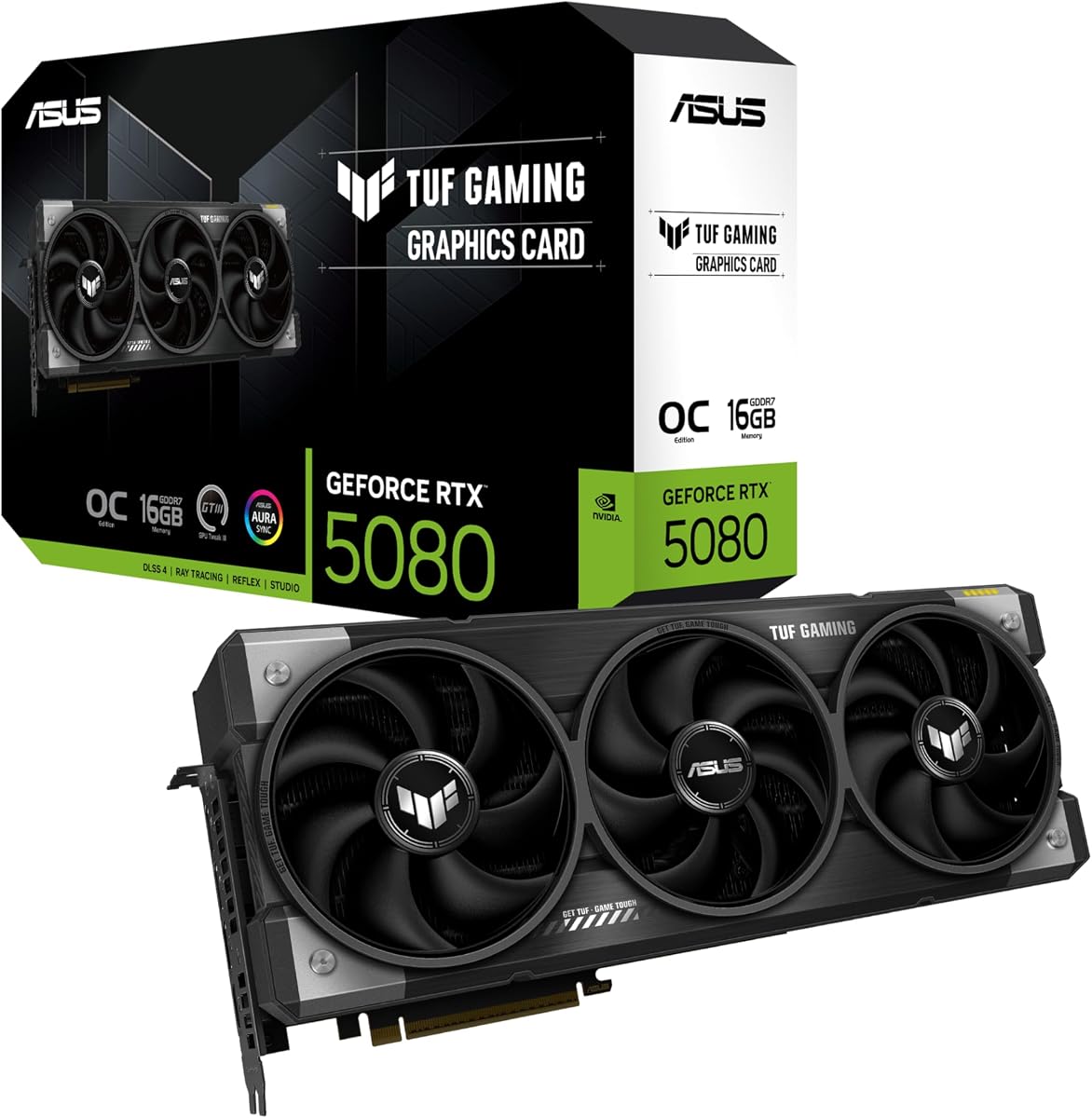
This ASUS TUF RTX 5080 stands out as the best premium ray tracing card. With a 4.6 rating, it combines power with durability. Military-grade components ensure longevity under stress.
We may earn a commission when you buy through this link, at no additional cost to you.
Its strengths include phase-change thermal pads and Auto-Extreme manufacturing for reliability. The card handles demanding games effortlessly. GPU Tweak III offers precise control over performance.
Trade-offs include high cost and size. These are justified by the premium build quality and performance guarantees. It suits enthusiasts wanting the absolute best.
High-end builders seeking durability and power should buy this. It sets the standard for premium graphics cards.
Military-grade components provide rock-solid power delivery for long-term stability and enhanced lifespan.
Phase-change pads ensure optimal heat transfer under heavy loads for consistent clock speeds.
We may earn a commission when you buy through this link, at no additional cost to you.
The ASUS Dual RTX 5060 Ti delivers efficient ray tracing performance. Rated 4.7, it features 16GB GDDR7 and 767 AI TOPS. Its compact 2.5-slot design suits smaller cases.
We may earn a commission when you buy through this link, at no additional cost to you.
Strengths include advanced Blackwell architecture for improved efficiency. Axial-tech fans provide excellent cooling in small form factors. Dual BIOS offers flexibility for quiet or performance modes.
Trade-offs include limited VRAM for max resolution gaming. Core counts are lower than high-end cards. These are acceptable for mid-range builds.
Gamers needing efficient ray tracing should buy this. It offers great performance in a compact package.
767 AI TOPS enable advanced generative features and upscaling for enhanced visual quality.
2.5-slot design ensures easy installation in compact builds without sacrificing cooling performance.
We may earn a commission when you buy through this link, at no additional cost to you.
This ASUS TUF RTX 5070 offers balanced performance. Rated 4.7, it features military-grade components and efficient cooling. Its design ensures reliability without excessive bulk.
We may earn a commission when you buy through this link, at no additional cost to you.
Strengths include Auto-Extreme manufacturing for higher reliability. GPU Tweak III allows easy performance tweaks. The phase-change thermal pad keeps temps low under load.
Trade-offs involve 12GB VRAM limitations for 4K gaming. Price is moderate compared to lower tiers. These are acceptable for 1440p targeting.
Gamers wanting reliability and balanced power should buy this. It fits mainstream high-performance setups well.
Military-grade components ensure solid power delivery and enhanced durability over the card lifespan.
Phase-change thermal pads ensure optimal heat transfer for consistent performance under heavy loads.
We may earn a commission when you buy through this link, at no additional cost to you.
The ASUS Dual RX 9060 XT is the best budget ray tracing pick. With 4.7 stars, it offers 16GB GDDR6 at an affordable price. Axial-tech fans keep it quiet.
We may earn a commission when you buy through this link, at no additional cost to you.
Strengths include a 2.5-slot design for small cases and dual BIOS options. 0dB technology ensures silence during light gaming. It supports entry-level ray tracing well.
Trade-offs include weaker ray tracing and lower resolution focus. These are acceptable given the value. It is ideal for first-time builders.
Budget gamers needing basic ray tracing should buy this. It provides essential features without breaking the bank.
0dB technology ensures fans stop spinning during low loads for a whisper-quiet experience.
Best budget value delivering solid entry-level ray tracing capabilities at an accessible price point.
We may earn a commission when you buy through this link, at no additional cost to you.
This ASUS TUF RTX 5070 Ti boasts the highest rating. It combines 16GB GDDR7 with Blackwell architecture. Military-grade components ensure durability and consistent performance.
We may earn a commission when you buy through this link, at no additional cost to you.
Strengths include phase-change thermal pads and Auto-Extreme manufacturing for reliability. It handles demanding ray tracing workloads effortlessly. GPU Tweak III provides full control.
Trade-offs involve high price and physical size. These are justified by its performance. It fits users wanting high-end power without top-tier costs.
Gamers seeking near-flagship performance should buy this. It delivers exceptional reliability and power.
Military-grade components deliver rock-solid power and longer lifespan for ultimate durability.
Phase-change thermal pads outlast traditional paste to ensure optimal thermal performance under load.
We may earn a commission when you buy through this link, at no additional cost to you.
The GIGABYTE RTX 5070 Gaming OC provides reliable mid-range ray tracing. Rated 4.8, it features 12GB GDDR7 and PCIe 5.0. WINDFORCE cooling ensures stable performance.
We may earn a commission when you buy through this link, at no additional cost to you.
Strengths include fast memory speeds for efficient rendering. Blackwell architecture supports DLSS 4 for enhanced visuals. It offers good price-performance for mainstream gamers.
Trade-offs involve 12GB VRAM limits and moderate ray tracing. These are acceptable for 1440p users. It balances cost and performance well.
Gamers needing reliable mid-range power should buy this. It fits high-performance budgets easily.
12GB GDDR7 offers significantly faster data transfer rates compared to standard DDR6 memory.
PCIe 5.0 interface ensures compatibility with next-generation systems for maximum bandwidth.
We may earn a commission when you buy through this link, at no additional cost to you.
This ZOTAC RTX 4070 Super offers compact ray tracing power. Rated 4.8, it uses Ada Lovelace and DLSS 3. IceStorm 2.0 cooling ensures quiet performance in small cases.
We may earn a commission when you buy through this link, at no additional cost to you.
Strengths include Spectra RGB lighting and compact design. It supports 8K ready outputs. The card fits SFF builds while maintaining solid performance.
Trade-offs involve older architecture and PCIe 4.0 limit. These are manageable for 1440p gaming. It suits users needing space efficiency.
SFF gamers wanting strong ray tracing should buy this. It delivers power in a compact footprint.
Twin Edge compact design fits small cases without sacrificing thermal performance or visual appeal.
IceStorm 2.0 Advanced Cooling ensures efficient heat dissipation even in restricted airflow environments.
We may earn a commission when you buy through this link, at no additional cost to you.
Selecting the right graphics card requires understanding key technical factors. This guide breaks down specifications that impact ray tracing performance directly.
Modern architectures like NVIDIA Blackwell or AMD Radeon RX 9000 series offer dedicated ray tracing cores. Newer generations provide better efficiency and features like DLSS 4.
Always choose the latest available architecture for future-proofing and best performance.
Ray tracing increases texture complexity, requiring more VRAM. 16GB is ideal for 1440p and 4K gaming to avoid stuttering.
Select at least 16GB VRAM if possible for high-resolution and texture-heavy games.
GDDR7 and GDDR6X speeds determine how quickly data moves to ray tracing cores. Higher bandwidth reduces latency and boosts frame rates.
Prioritize cards with high-speed memory interfaces for smoother performance.
Ray tracing demands sustained performance which generates heat. Look for advanced fan designs and thermal pads to prevent thermal throttling.
Choose cards with robust cooling systems to maintain stable clock speeds.
PCIe 5.0 provides maximum bandwidth for data transfer between CPU and GPU. It ensures the GPU gets data fast enough for complex scenes.
Prioritize PCIe 5.0 support for next-gen system compatibility.
Features like DLSS and frame generation rely on specific software. Newer models support these technologies more effectively for higher performance.
Ensure the card supports the latest upscaling and generation tools.
Military-grade components and PCB coatings protect against moisture and dust. This ensures longevity and reliability during heavy use.
Look for durable components to ensure consistent performance over time.
High-end cards need robust PSUs. Verify wattage and connector types before purchasing to avoid compatibility issues.
Check PSU requirements carefully before buying any high-power card.
Install drivers correctly to enable all ray tracing features. Visit manufacturer websites for the latest software updates and control panel tools.
Clean dust from fans and heatsinks every few months. This maintains cooling efficiency and prevents overheating issues.
Use monitoring software to track temperatures and clock speeds. Adjust fan curves manually if noise is an issue during gameplay.
Not all cards support ray tracing efficiently. Dedicated cores in newer NVIDIA and AMD models are essential for smooth performance.
4K ray tracing generally requires 16GB or more of VRAM to handle high-resolution textures and complex lighting without stuttering.
Yes, DLSS boosts frame rates significantly by rendering at lower resolutions and upscaling with AI. This allows higher ray tracing settings.
NVIDIA generally leads in ray tracing performance due to dedicated cores and optimized software. AMD competes well in raw power.
Modern CPUs are recommended to avoid bottlenecks. Ensure your CPU is capable of high clock speeds and multi-core performance for balanced systems.
High-end cards typically need 850W or more PSUs with 12VHPWR connectors. Verify your power supply before purchasing any top-tier card.
We highlighted top models like the GIGABYTE RTX 5080 and ASUS TUF series. Each offers distinct strengths for different needs and budgets.
Prioritize VRAM, cooling, and architecture when selecting. These factors ensure smooth ray tracing performance over time.
Prices change frequently so always check current listings before finalizing your purchase. Stay informed to secure the best deal available.