
D-FantiX
4.5Editor score
No battery needed
Analog display
Lightweight
Find the best battery tester for household batteries with our expert guide comparing top models for accuracy, compatibility, and ease of use today.
Keeping your devices powered requires knowing when batteries need replacement. A reliable tester eliminates guesswork and saves money by identifying weak cells before they fail.
We compared ten top-rated testers based on compatibility, display clarity, and portability. Our analysis covers analog and digital options suitable for AA, AAA, C, D, 9V, and button cells.
Each pick highlights specific strengths like magnetic design or load testing. Prices and availability change frequently, so check current listings before making your final purchasing decision.
4.5Editor score

4.6Editor score

4.6Editor score
This table summarizes key specifications for each tester to help you quickly identify the right model for your specific battery types and testing needs.




The Tenergy T-333 earns top marks for its universal compatibility and clear LCD screen. With a 4.6 rating, it efficiently checks AA through 9V batteries plus various button cells.
We may earn a commission when you buy through this link, at no additional cost to you.
Its standout feature is the ability to test 12 different battery types including CR123A and CRV3. The LCD display ensures you see voltage and status clearly without guessing.
While it requires a separate AAA battery to operate, this allows for consistent readings across different battery types. The compact design fits easily in tool kits.
Ideal for households with mixed battery types, this tester balances functionality and portability. It remains our top recommendation for general home electronics maintenance.
Supports standard alkaline and specialized lithium batteries for versatile household use.
Lightweight and small enough to store in drawers or take on camping trips.
We may earn a commission when you buy through this link, at no additional cost to you.
The D-FantiX model offers exceptional value by requiring no external power source to operate. Its analog needle moves to indicate green, yellow, or red status zones.
We may earn a commission when you buy through this link, at no additional cost to you.
Users appreciate the simplicity of inserting a battery and instantly seeing its health. The compact size makes it easy to keep near storage areas for quick checks.
While it lacks digital precision, the color-coded scale is sufficient for most household needs. It helps prevent wasting good batteries by confirming if a device needs new power.
Best for casual users who want a no-fuss tool without ongoing costs. It delivers reliable basic checks for remotes and toys efficiently.
Operates solely on the voltage of the battery being tested for infinite lifespan.
Color-coded scale allows instant recognition of battery health status.
We may earn a commission when you buy through this link, at no additional cost to you.
La Crosse distinguishes itself by accurately testing both alkaline and rechargeable Ni-MH batteries. This capability is essential for households relying on rechargeables for high-drain devices.
We may earn a commission when you buy through this link, at no additional cost to you.
The simple tray mechanism ensures correct polarity every time, reducing user error. LED indicators provide clear strength levels alongside voltage readings.
Though pricier than analog alternatives, the precision justifies the cost for tech-savvy users. It prevents damage to devices by catching weak rechargeables early.
Recommended for those needing reliable rechargeable testing. Its robust design ensures long-term accuracy for household and professional use.
Specific voltage ranges for 1.2V Ni-MH batteries ensure correct testing results.
Mechanism guides insertion to prevent reverse polarity damage during testing.
We may earn a commission when you buy through this link, at no additional cost to you.
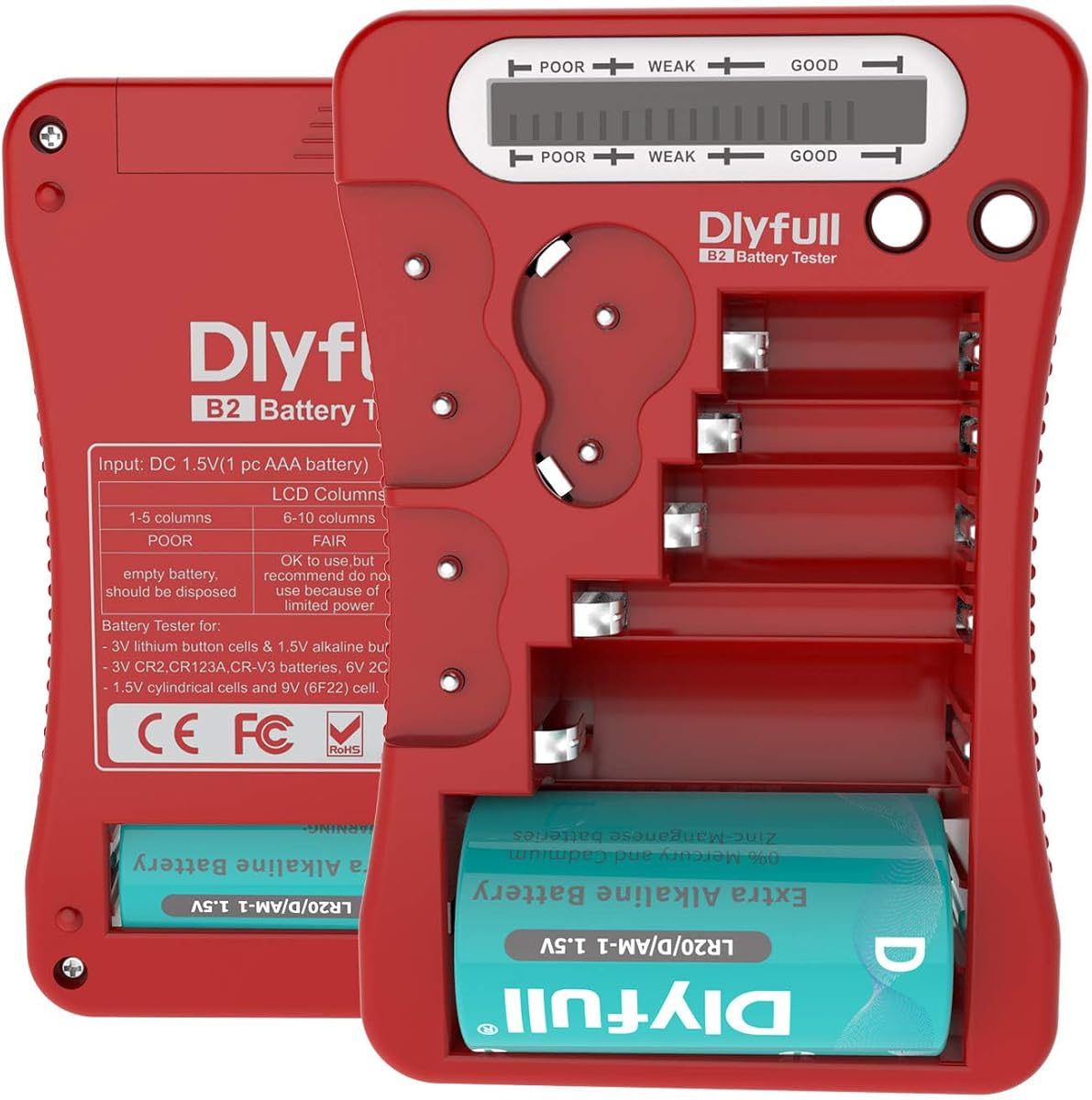
The Dlyfull model features a slim chassis designed specifically for portability. Its crisp LCD screen offers quick status indicators like bars for poor or good health.
We may earn a commission when you buy through this link, at no additional cost to you.
Users value the fast testing process and the included AAA battery. It handles standard AA, AAA, and 9V cells efficiently for general maintenance.
The anti-slip finish ensures a firm grip during testing, enhancing safety. While not designed for rechargeables, it is effective for alkaline management.
A solid choice for travelers or those needing a pocket-sized checker. The warranty adds confidence to the purchase decision.
Rapidly displays battery health to save time during bulk testing.
Includes an 18-month warranty for reliable customer service coverage.
We may earn a commission when you buy through this link, at no additional cost to you.
This versatile tester covers an extensive range of battery types including CR2032 and 1.2V rechargeables. It uses real-load testing to give precise voltage readings.
We may earn a commission when you buy through this link, at no additional cost to you.
The auto-shutoff feature conserves power when not in use. Power level bars provide instant feedback on remaining battery life.
Its durable construction protects contacts and batteries during frequent use. The lack of a backlight is a minor downside in dim environments.
Ideal for hobbyists needing broad compatibility. It offers technical precision without a steep learning curve.
Uses discharge resistors to measure voltage under realistic conditions.
Shuts off after 3 seconds to preserve internal battery life.
We may earn a commission when you buy through this link, at no additional cost to you.
Similar to the Dlyfull series, this model focuses on portability and speed. Its compact design makes it easy to keep in a toolbox or drawer.
We may earn a commission when you buy through this link, at no additional cost to you.
Users highlight the quick testing process and clear LCD analyzer. It is particularly useful for testing 1.5V and 3V button cells accurately.
The anti-slip finish prevents accidental drops during testing. While it lacks advanced features, it covers essential household needs well.
Best for those seeking a lightweight backup checker. The warranty ensures long-term satisfaction.
Small chassis fits easily into pockets or small storage compartments.
Rapidly determines health status to minimize device downtime.
We may earn a commission when you buy through this link, at no additional cost to you.
Getting two testers for a low price makes this option excellent for multiple locations. They operate without external power, ensuring readiness whenever needed.
We may earn a commission when you buy through this link, at no additional cost to you.
Users value the portability and ease of use for simple voltage checks. One can stay in the kitchen and one in the office.
The design is basic but functional, using indicator bars for status. It helps avoid purchasing new batteries unnecessarily.
Ideal for households needing multiple testing points. It is a practical solution for general maintenance.
Buying two units provides coverage in different areas for minimal cost.
Requires no internal battery, ensuring it is always ready to use.
We may earn a commission when you buy through this link, at no additional cost to you.
Gardner Bender brings a professional touch to household testing with included test leads. This allows for testing batteries that do not fit standard slots.
We may earn a commission when you buy through this link, at no additional cost to you.
Its 14 battery range covers specialized types like 12V packs. The analog scale offers a visual representation of charge levels.
The durable black housing withstands workshop conditions well. While bulkier, it is robust for frequent heavy use.
Best for workshops or specialized electronics. It provides flexibility beyond standard battery slots.
Allows testing of batteries without physical contact slots for maximum flexibility.
Covers 14 different battery ranges for specialized and common types.
We may earn a commission when you buy through this link, at no additional cost to you.
The magnetic tip on the Dlypow model holds the battery in place for stable contact. This ensures consistent signal strength and accurate readings.
We may earn a commission when you buy through this link, at no additional cost to you.
Users appreciate the clarity without complexity. The analog display is easy to read even for those unfamiliar with electronics.
Its durable materials promise long-term reliability. It is an affordable way to upgrade basic testing capabilities.
Great for those who prefer innovative tools. The magnetic feature adds a unique advantage to testing.
Built-in tip ensures firm contact to prevent signal interference.
Simple one-step process makes it accessible for all household members.
We may earn a commission when you buy through this link, at no additional cost to you.
This tester stands out with its smart LCD displaying battery levels as percentages. It covers 12 types including Li-ion and Ni-MH batteries.
We may earn a commission when you buy through this link, at no additional cost to you.
The self-test function ensures the device is functioning before use. Users like the precise percentage readings for detailed monitoring.
Weighing less than 0.36 pounds, it remains portable despite the advanced features. The AAA battery requirement ensures consistent internal power.
Ideal for tech enthusiasts needing data precision. It combines versatility with smart reporting features.
Shows remaining power as a percentage for precise monitoring.
Built-in self-test ensures the tester itself is powered and working.
We may earn a commission when you buy through this link, at no additional cost to you.
Selecting the right tester depends on your specific battery types and how much detail you need about their health.
Ensure the tester covers your common household batteries like AA, AAA, C, D, and 9V. Advanced models may also handle button cells and rechargeables.
Always check the product specifications to confirm it supports the types you use most frequently.
Digital LCD screens provide precise voltage readings, while analog displays offer quick visual status through color zones.
Choose digital for detailed monitoring and analog for quick, simple checks.
Some testers require an internal battery to operate, while others are passive and run on the battery being tested.
Passive models save long-term costs, while active ones often offer more precise readings.
Compact designs are essential if you plan to carry the tester in a tool kit or drawer.
Look for lightweight models with anti-slip finishes for secure handling.
Higher-end testers often include load testing to simulate real-world usage conditions.
Accuracy is vital for preventing damage to sensitive electronics.
Simple insertion slots and clear indicators make testing accessible for all users.
Avoid complex models if you only need basic status checks.
Insert the battery into the correct slot ensuring the polarity matches the markings on the device.
Wait for the display to stabilize before reading the voltage or status bars.
Store the tester in a dry place and replace its internal battery if it stops powering on.
Yes, many modern testers are designed to handle rechargeable Ni-MH batteries. Ensure the device explicitly states compatibility with 1.2V rechargeables.
Analog testers provide a general range like good or bad but lack precise voltage numbers. They are sufficient for most household needs but less accurate than digital models.
Standard testers measure voltage which indicates current charge but not actual capacity. Load testers offer better insights but do not measure full capacity.
Some models require an internal AAA battery to power the screen and circuitry while others operate passively without any internal power source.
Durability depends on build quality. Most are robust enough for years of light home use if stored properly.
Yes, most universal testers include slots or adapters specifically for round button cells like CR2032.
We highlighted the Tenergy T-333 as the top all-rounder for its balance of features and accuracy.
Consider your specific needs such as rechargeable testing or budget constraints before purchasing.
Always verify current prices and availability online before making your final purchase decision.